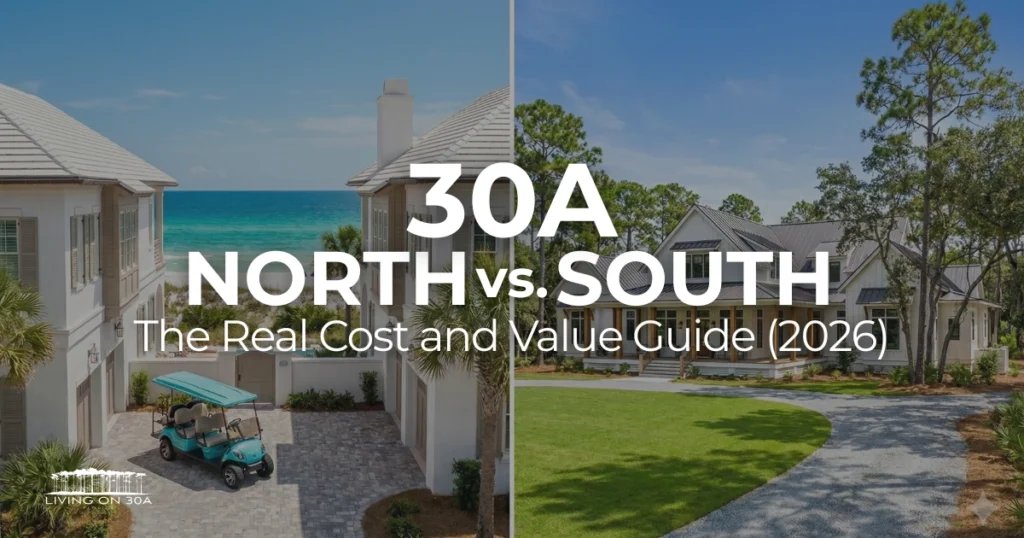

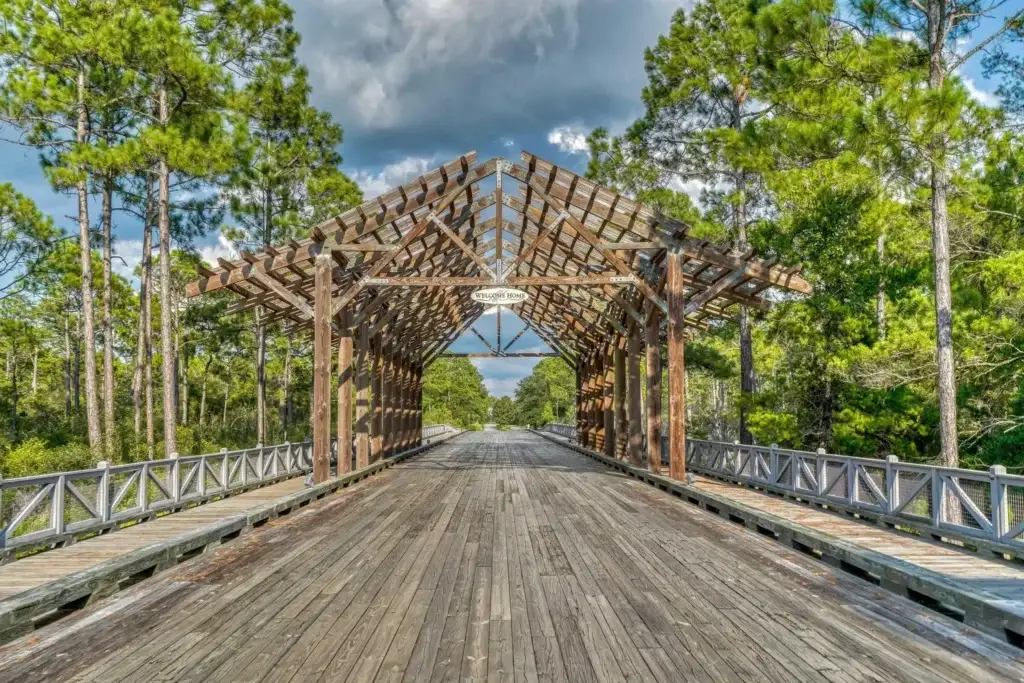
If you have driven 30A, you have probably passed NatureWalk at Seagrove without knowing it. It sits just north of the Publix at WaterColor Crossings, tucked behind a wooden bridge and a wall of pines. Living in NatureWalk at Seagrove is a different proposition than living in the pastel beach towns to the south, and that difference is the entire point. This is the forest side of 30A, and for the right buyer it can be the smartest money on the street.
What It’s Like Living in NatureWalk at Seagrove
Living in NatureWalk at Seagrove means trading a Gulf-front address for forest privacy, with the 15,000-acre Point Washington State Forest wrapping three sides of the neighborhood and the beach about a mile south. This Kolter-built community of just under 300 cottage-style homes centers on a resort-grade amenity hub called The Gathering Place, and short-term rentals are permitted with the proper county license.
The appeal here is a balance most 30A communities cannot offer. You get genuine quiet and tree-canopy privacy, and you are still a short bike or golf cart ride from Seaside, WaterColor, and the sand. You are buying calm without buying isolation. For buyers coming from the tighter, see-and-be-seen streets to the south, that combination is the draw. If you want the full lay of the land first, our complete 30A guide maps how the towns differ and why the value shifts north versus south of 30A.
First, Clear Up the Name Confusion
There are two “NatureWalks” the 30A area, and people mix them up constantly. NatureWalk at Seagrove is the Kolter community off County Road 395 next to WaterColor. It has nothing to do with NatureWalk at Watersound Origins, a separate development several miles east near Watersound. If you are searching listings or comparing homes, confirm which one you are actually looking at. The price points and the feel are not the same, a theme that runs through a lot of how 30A is laid out once you start digging.
The Forest on Three Sides
NatureWalk borders Point Washington State Forest, roughly 15,000 acres of pine flatwoods, sandhills, and trails managed by the Florida Forest Service. That forest is the reason the community feels secluded even though Seaside is minutes away. Residents have direct access to hiking and mountain-biking trails most 30A buyers never touch. The trade-off is simple and worth saying plainly: your backyard view is woods and preserve, not water.
The Homes: Style, Size, and Price
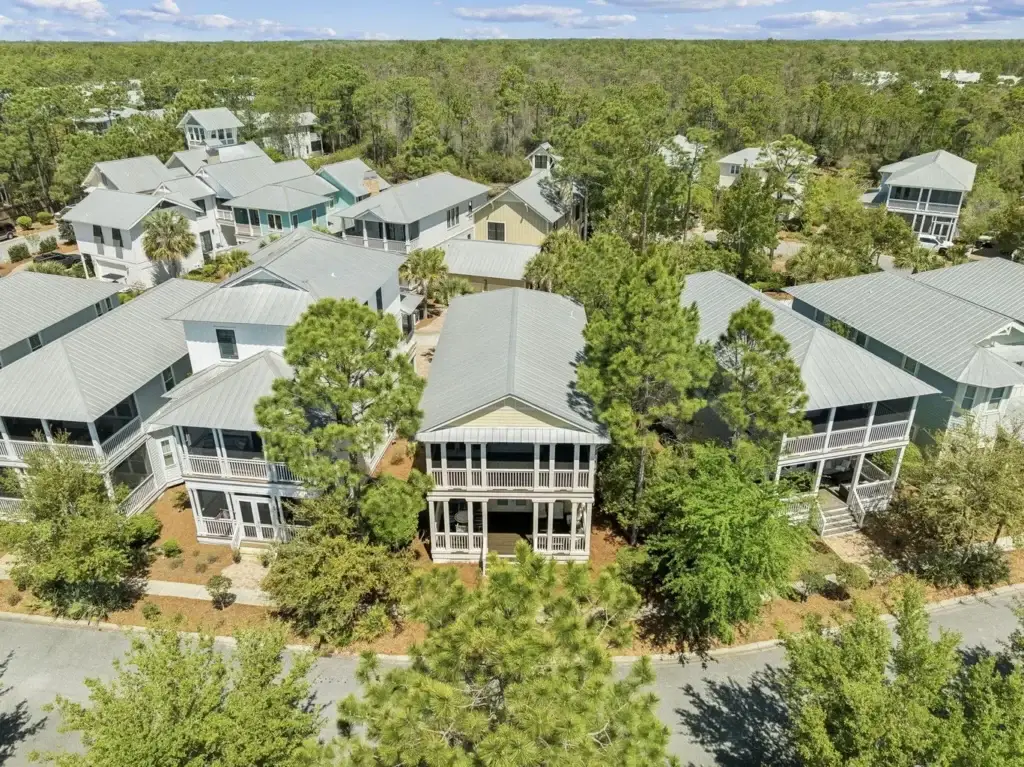
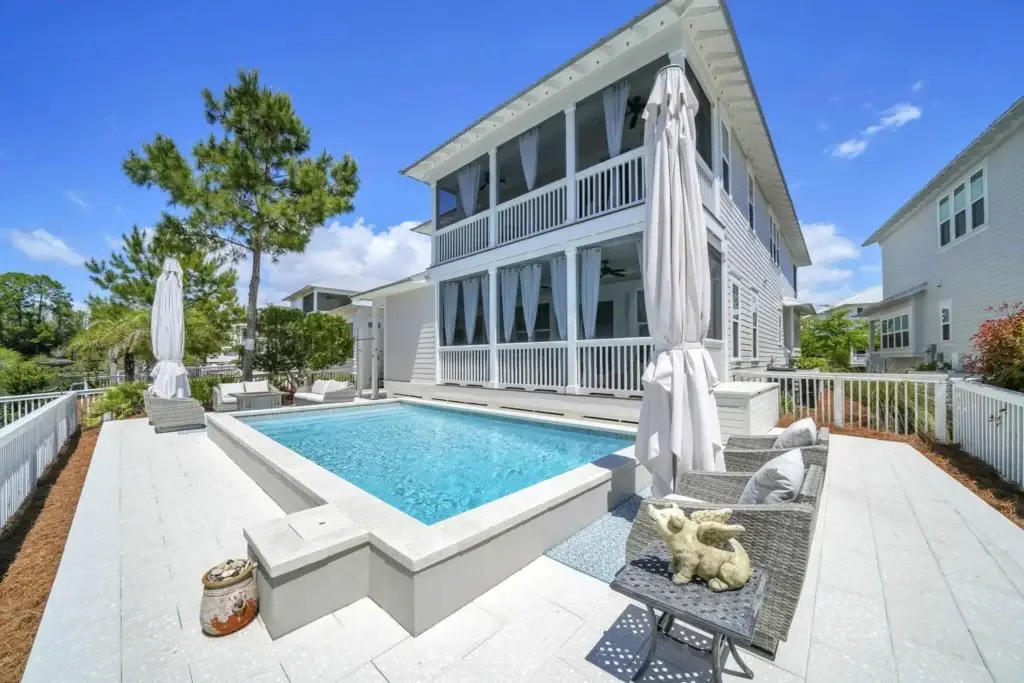
NatureWalk is built almost entirely by Kolter Homes in a Southern vernacular cottage style, drawn from the Village and Cottage collections. Most homes are two stories, though a handful of single-story floor plans exist and tend to move fast because they are rare. Expect porches, metal roofs, and finishes pitched at the second-home and primary-residence buyer rather than the bargain hunter.
On price, here is what the local MLS actually shows rather than what a listing portal estimates. Over the trailing twelve months, 32 homes sold in NatureWalk, ranging from $950,000 to roughly $1.85 million, with an average sold price right around $1.26 million. Sold prices have run about $517 per heated square foot, and homes have generally closed near 95% of list price after about three months on market. As of this writing there are 9 active listings, priced from about $1.07 million to $1.75 million. This is a real, liquid market, not a handful of stale listings.
The Gathering Place and Daily Life
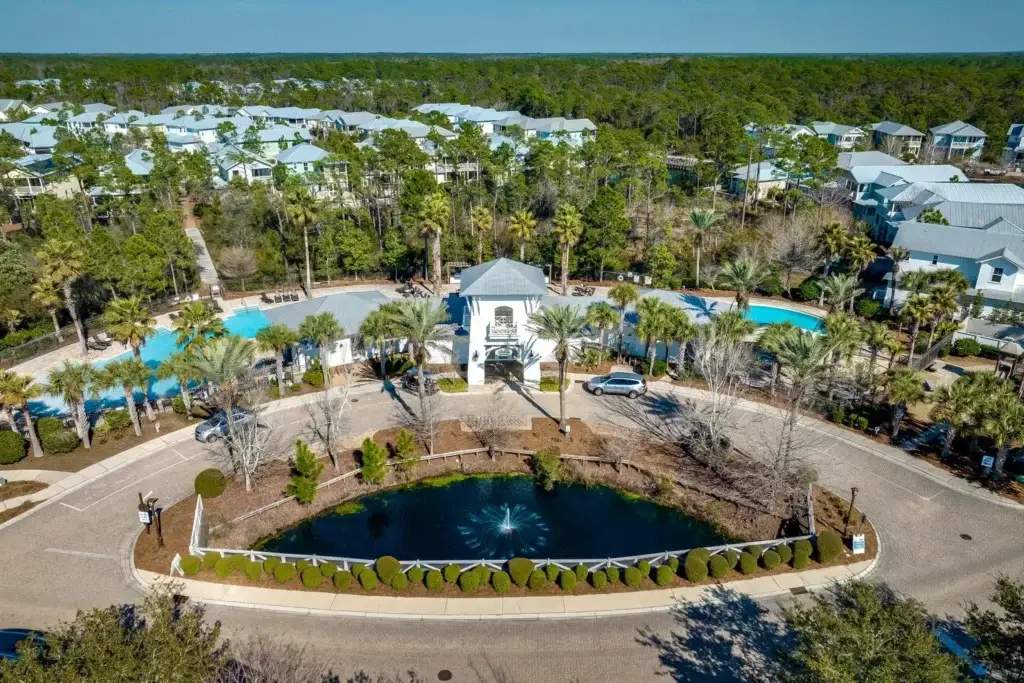
The social center of NatureWalk is The Gathering Place, a gated amenity complex that does a lot of the work a beachfront would otherwise do. It includes a family-friendly beach-entry pool, a children’s pool, a heated lap pool for actual exercise, a hot tub, fire pits, grills, hammocks, and a playground. There is also a fitness trail with workout stations and pickleball. For families and for rental guests, this is the heart of the community, and it is a meaningful reason homes here rent well despite the distance from the sand.
Getting to the Beach
This is where you have to be honest with yourself. The nearest beach access is about a mile south. The community’s Lily Lane Beach Trail is a wide, compacted path for walking and biking that connects toward San Juan Avenue, and the Santa Clara (Bramble Grove) public access just east has a parking lot and restrooms. But golf carts are prohibited from using the trail. By bike it is an easy seven-minute trip. On foot in August heat with beach chairs, it is a real walk. If beach proximity is non-negotiable for you, weigh that against how public and private beach access works on 30A before you fall for the forest.
Everyday errands are easier here than in most of 30A. WaterColor Crossings sits right at the entrance with a Publix, plus spots like Pizza by the Sea and The Perfect Pig. Drop down to 30A and you have 723 Whiskey Bravo, The Surfing Deer, and Bud and Alley’s within a few minutes. That convenience is a quiet advantage over more remote stretches of the beach. If you are weighing neighbors, it is worth seeing how living in WaterColor and living in Seaside compare on cost and character, since both sit within bike distance.
The Cost of Ownership Nobody Explains: HOA Plus CDD
Here is the part most buyers miss, and most agents gloss over. NatureWalk carries two separate cost layers: a Homeowners Association and a Community Development District, or CDD. They are not the same thing, and you pay both.
The HOA dues are $1,007 per quarter, or about $4,028 per year, and they fund the amenities, common areas, and management.
The CDD is the piece that surprises people. A CDD is a special-purpose government unit that financed the neighborhood’s original infrastructure, the roads, bridges, storm sewers, and trails, through tax-exempt bonds issued back in 2007. You repay your share through a non-ad valorem assessment on your Walton County tax bill. That assessment has two components. A fixed bond, or debt portion, that never changes and matures around 2037, and an operations-and-maintenance portion that adjusts slightly each year.
For the current fiscal year, a smaller 35-foot lot pays about $3,211 in total CDD assessment, and a larger 45-foot lot pays about $4,137. Here is the detail that matters most: some homeowners have already paid off the bond portion in full. If you buy one of those homes, your debt portion is zero and you only inherit the operations piece. That single line item, “CDD bond paid in full,” can be worth thousands and it is one of the first things I check on any NatureWalk listing.
| Annual carrying cost | Smaller cottage (35′ lot) | Larger home (45′ lot) |
|---|---|---|
| HOA dues | $4,028 | $4,028 |
| CDD operations and maintenance | $2,072 | $2,673 |
| CDD bond and debt (if not prepaid) | $1,138 | $1,464 |
| Total if bond still owed | $7,238 | $8,165 |
| Total if bond paid in full | $6,100 | $6,701 |
Those figures are HOA and CDD only. Property taxes and insurance are separate, and I cover taxes next.
Property Taxes on a NatureWalk Home
Good news here. Walton County runs one of the lowest county millage rates in Florida, and the county commission actually lowered its portion for the 2026 fiscal year. The countywide median effective property tax rate sits around 0.74% of value, well under the Florida average. As a rough budgeting rule, plan on somewhere near 0.8% to 1.0% of your purchase price annually for a non-homestead second home, then confirm the exact figure for any specific address with the Walton County Property Appraiser. If NatureWalk becomes your primary residence, Florida’s homestead exemption and the 3% Save Our Homes cap change the math in your favor. We break down the broader picture in our guide to what full-time life on 30A actually costs.
Investment Potential: Rental Rules and ROI
NatureWalk works as an investment, but you have to be clear-eyed about the numbers. This is not a Gulf-front rental machine, and pretending otherwise sets owners up for disappointment.
Are Short-Term Rentals Allowed?
Yes. NatureWalk permits short-term rentals, and the community has a healthy mix of full-time residents, second homeowners, and part-time rental owners. There is no separate community rental registration, but you are required to obtain Walton County’s short-term rental permit and comply with Florida’s vacation-rental licensing before you book a single guest. The neighborhood enforces quiet hours and pool rules, which keeps the rental side from overwhelming the residential feel. Note that boats, RVs, and trailers are not permitted in the community.
What You Can Actually Earn
Here is the honest range, and it is wider than the listing portals suggest. A smaller home without a private pool typically grosses around $65,000 to $70,000 per year. A larger home with a private pool can reach roughly $140,000 per year. The single biggest factor pulling income down is the distance from the beach. Renters pay a premium for sand-in-thirty-seconds, and NatureWalk cannot offer that, so it competes on amenities, space, and value instead.
When you see a listing advertising a six-figure rental projection on a modest home, treat it as a marketing number until your advisor reconciles it against real booking data. Management companies on 30A typically take 20% to 30% of gross, and that comes off the top before you ever see a dollar. If you are comparing rental performance across communities, the same honesty applies whether you are looking here or at Seagrove and Grayton Beach side by side.
The Honest Trade-Offs
Let me put the cons in one place, because the brochures never will.
You will not have a water view, and you will not walk out your door onto the beach. You will pay two layers of community cost, the HOA and the CDD, and you need to know the bond status of any home before you write an offer. Most homes are two-story, which matters if stairs are a concern. And the very thing that makes NatureWalk special, the forest and the quiet, is the thing that caps its rental ceiling compared to Gulf-front product.
Now the other side. You get privacy and tree canopy that communities like Rosemary Beach and Alys Beach, with their rigid design codes and dense streetscapes, simply do not offer. You get newer construction, strong amenities, grocery and dining at your entrance, and an entry price that, for 30A, is relatively sane. For a primary residence or a second home where peace matters more than a rental spreadsheet, that is a genuinely compelling package.
If you are still mapping the area, it helps to understand the drive in from the nearest airports, what relocating to 30A involves, and the best months to actually visit 30A before you commit to a community. It is also worth seeing how the nearby communities stack up, from the WaterColor and Watersound comparison to how Seaside and WaterColor compare for families and the funkier, older feel of Grayton Beach.
Frequently Asked Questions
Is NatureWalk at Seagrove a good place to live full-time, or is it mostly vacation rentals?
It is genuinely mixed. NatureWalk has a real base of full-time and seasonal residents alongside part-time rental owners, and the quiet hours, gated amenities, and forest setting make it one of the more livable year-round communities at this price on 30A. The grocery and dining at WaterColor Crossings right at the entrance make daily life unusually convenient for the area.
Why does NatureWalk have both an HOA and a CDD, and how much does that cost?
The HOA funds amenities and management at $1,007 per quarter. The CDD is a separate special district that repays the neighborhood’s original infrastructure through an assessment on your county tax bill, currently around $3,211 to $4,137 per year depending on lot size. If a home’s bond portion is already paid in full, your CDD cost drops to just the operations piece, so always confirm the bond status before making an offer.
How far is NatureWalk at Seagrove from the beach, really?
The nearest public beach access is about a mile south. By bike or golf cart along the Lily Lane Beach Trail it is roughly a seven-minute trip, and the Santa Clara access has parking and restrooms. On foot it is a real walk, especially in summer, so most owners use a cart or bikes. Beach proximity is the main trade-off you accept in exchange for forest privacy and a lower entry price.
Thinking about a home in Naturewalk at Seagrove?
The bond status, the lot size, and the rental math are different on every home in NatureWalk, and those details decide whether a listing is a deal or a trap. Let’s walk through the specific homes that fit what you actually want. Book a no-pressure discovery call or feel free to reach out to me directly and I’ll give you the honest read.
Call/Text Andy: 850-585-0642 or andy@livingon30aflorida.com