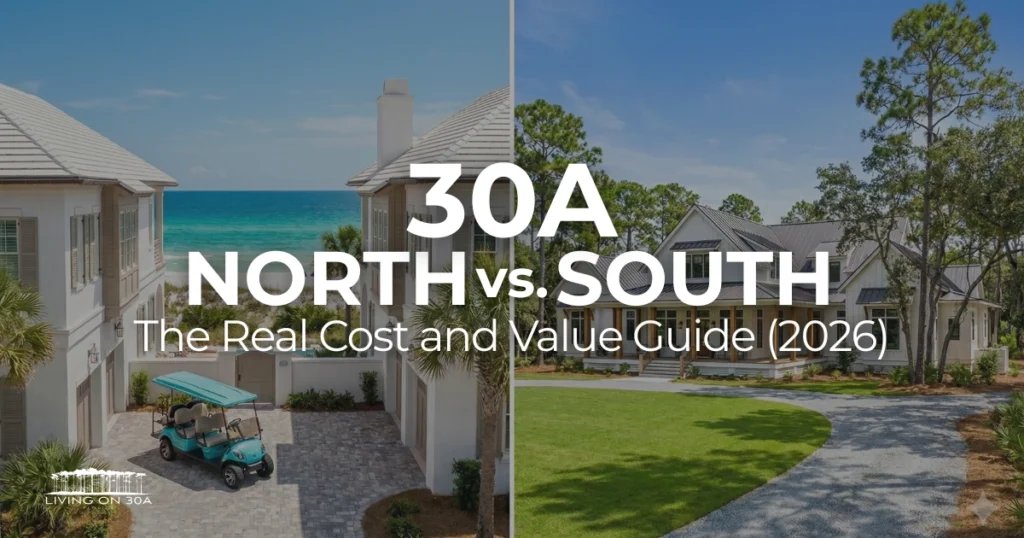

Rosemary Beach and WaterColor come up in the same conversation constantly, usually because a buyer has narrowed to “walkable, established, strong resale” and both fit. Then they see the price per square foot and the conversation changes. These are not two versions of the same thing. They are two different products sold to two different buyers, and the sold data makes that obvious.
I pulled the last twelve months of closed sales in both communities from the Emerald Coast MLS. Here is what the numbers actually say, what they cost to carry, and which one fits which buyer.
Rosemary Beach vs. WaterColor: The Short Answer
Rosemary Beach and WaterColor are two different products at two different prices. Over the trailing twelve months, Rosemary detached homes sold at a median of $1,406 per square foot against WaterColor’s $993. Rosemary buys a walkable New Urbanist town. WaterColor buys a managed resort with roughly three times the transaction volume.
Rosemary Beach sits at the east end of 30A, next to Inlet Beach. WaterColor sits in the middle, wrapped around Western Lake and pressed up against Seaside. If you are still orienting yourself geographically, the geography of 30A is worth ten minutes before you tour anything, because east end and mid-30A behave like separate markets.
Two Different Products: A Town and a Resort
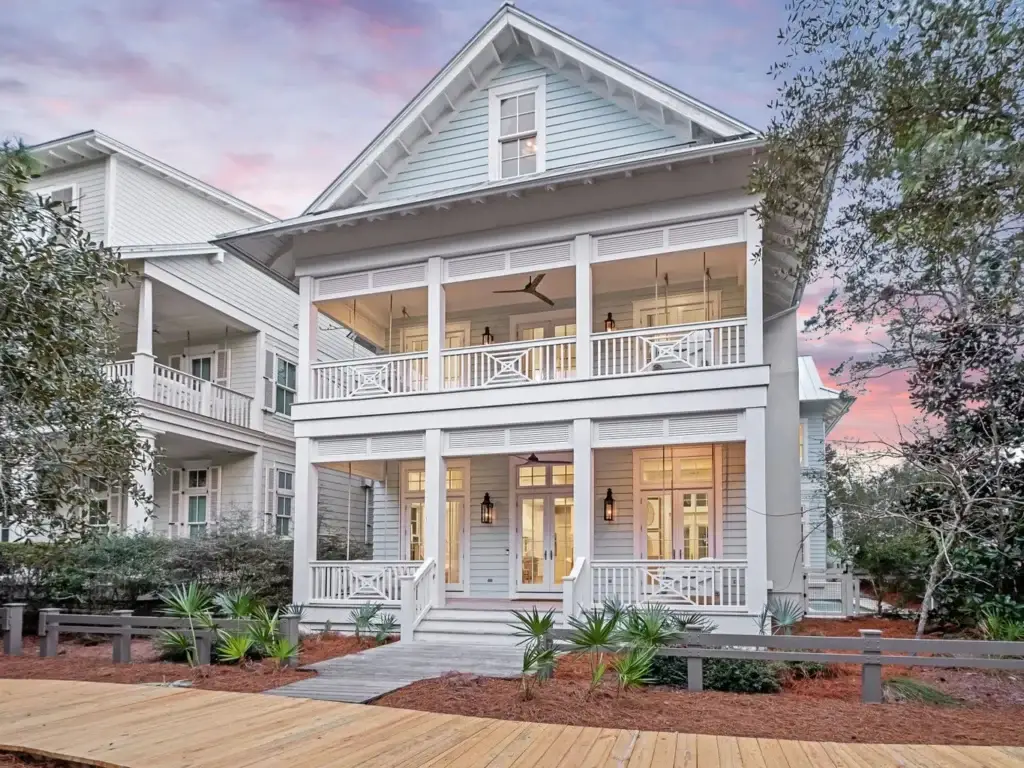
Rosemary Beach was designed as a town. Narrow streets, deep front porches, boardwalks over the dunes, a commercial center that anyone can walk into, and a design code that governs what you can build down to the roof pitch. You own a piece of a town and you answer to a design review board.
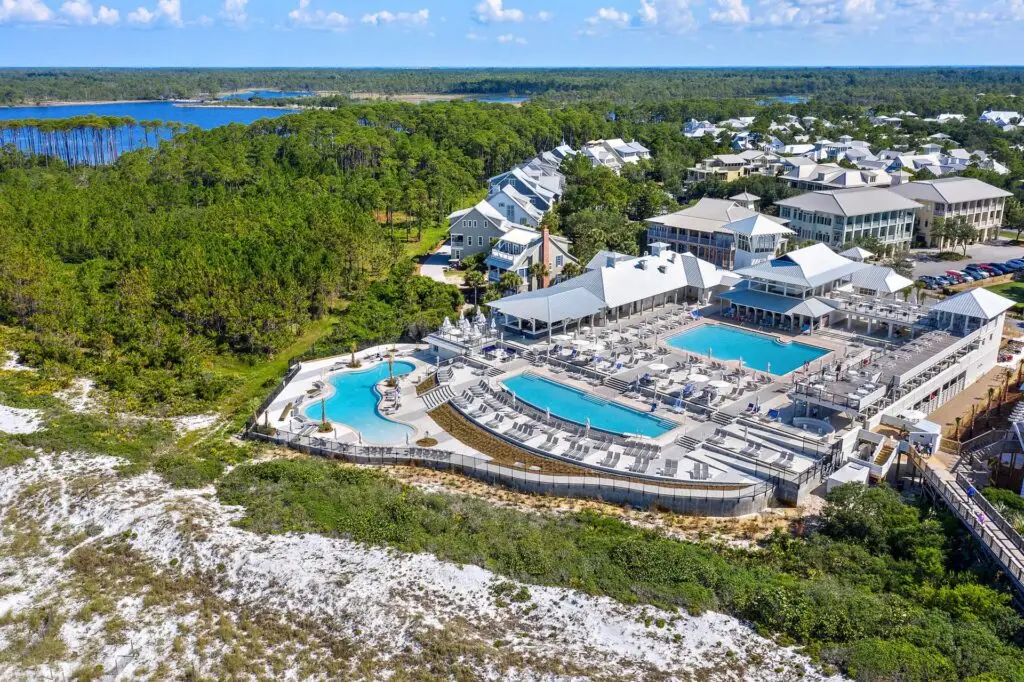
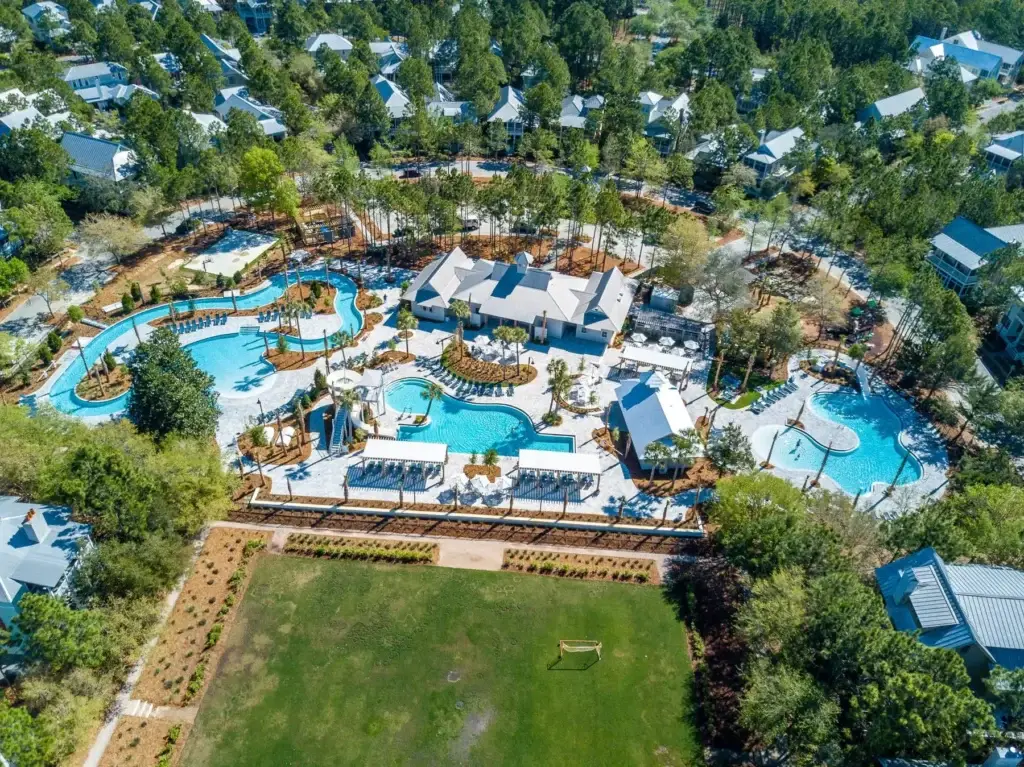
WaterColor was designed as a resort you can buy into. The Beach Club, Camp WaterColor, the boathouse on Western Lake, six pools, a trolley system, and an access-control operation that runs on RFID wristbands. You own a home inside a managed amenity business.
Neither of those is a criticism. They just attract different people. The buyer who wants to walk out the front door into a town and be left alone gravitates to Rosemary. The buyer with three kids under twelve who wants a camp program, a lifeguarded beach, and a trolley gravitates to WaterColor. Our WaterColor costs and rules guide and the Rosemary Beach design code breakdown go deeper on each individually.
What the Sold Data Actually Says
This is where most comparison articles hand-wave. Here are the closed numbers, pulled August 14, 2026, covering the trailing twelve months.
Detached single family homes
Rosemary Beach closed 27 detached sales at a median of $4,300,000 and a median of $1,406 per square foot. WaterColor closed 88 detached sales at a median of $3,000,000 and $993 per square foot.
Rosemary carries roughly a 42 percent premium per square foot. Here is what that means in practice. WaterColor’s median home is 3,070 square feet. Rosemary’s median home is 2,901 square feet. The WaterColor buyer got a slightly larger house for $1.3 million less. Run it the other way and a 2,901 square foot home priced at WaterColor’s median per foot comes to about $2.88 million instead of $4.3 million.
Volume and liquidity
WaterColor did $289.1 million in detached sales volume against Rosemary’s $132.7 million. That is 88 transactions versus 27. This matters more than buyers expect. A thinner market cuts both ways: less competition when you are buying, and a smaller buyer pool when you eventually sell. Rosemary is not illiquid, but it is a different exit.
Speed
WaterColor detached homes had a median 54.5 days on market. Rosemary ran 75 days. Both markets are bimodal, which is the more useful read. In WaterColor, 42 percent of homes sold within 30 days and 28 percent sat past 121 days. In Rosemary, 44 percent sold within 30 days and 37 percent sat past 121 days. Priced correctly, both move fast. Priced on hope, both sit for months. That pattern shows up across the luxury end of the 30A market.
Negotiation
Rosemary sellers held value slightly better against original list price, closing at 94.66 percent on average versus WaterColor’s 93.25 percent. Both markets saw average reductions in the 6 to 7 percent range from original list. Neither is a market where full-price offers are the norm.
Condos and townhomes
Rosemary closed 12 attached sales at a median $2,085,000 and $1,562 per square foot. WaterColor closed 8 at a median $1,650,000 and $1,213 per square foot. The WaterColor attached market is genuinely thin, with a median 178.5 days on market and only three of eight units selling inside 30 days. If you are shopping condos, understand you are entering a small, slow segment.
Rosemary Beach vs. WaterColor: Side by Side
| Category | Rosemary Beach | WaterColor | Edge |
|---|---|---|---|
| Median sold price, detached | $4,300,000 | $3,000,000 | WaterColor |
| Median price per sq ft, detached | $1,406 | $993 | WaterColor |
| Detached sales, trailing 12 mo | 27 | 88 | WaterColor |
| Detached sales volume | $132.7M | $289.1M | WaterColor |
| Median days on market, detached | 75 | 54.5 | WaterColor |
| Sold to original list, detached avg | 94.66% | 93.25% | Rosemary |
| Median sold price, attached | $2,085,000 | $1,650,000 | WaterColor |
| Median price per sq ft, attached | $1,562 | $1,213 | WaterColor |
| HOA dues, single family | $1,592/qtr ($6,368/yr) | $1,560/qtr ($6,240/yr) | Even |
| HOA dues, attached | ~$3,000 to $9,000/qtr | ~$4,000 to $8,000/qtr | Varies by building |
| Buyer transfer fee | 0.5% of purchase price | 0.5% of purchase price | Even |
| Per-night guest fee on rentals | None published | $9.00 per certified guest | Rosemary |
| Rental management | Independent managers allowed | Independent managers allowed | Even |
| Short-term rentals restricted anywhere | No | Yes, Park District (Phase 5) | Rosemary |
| Beach access | Keycard, community walkovers | RFID wristband, Beach Club | Even |
| Pools | 4 | 6 | WaterColor |
| Kids programming | Racquet Club, parks | Camp WaterColor | WaterColor |
| Walkable commercial center | Yes, Town Center | Yes, plus adjacent Seaside | Even |
Carrying Costs: Where the Assumption Breaks
Here is the finding that surprises almost every buyer I walk through this with.
Single-family HOA dues are effectively identical. Rosemary runs $1,592 per quarter. WaterColor runs $1,560 per quarter. That is $128 a year apart. Rosemary costs 42 percent more per square foot to buy and roughly the same to carry.
Attached product is a different story in both. Rosemary condo and townhome dues run from just over $3,000 per quarter to just over $9,000 per quarter depending on the building and location. WaterColor runs from just over $4,000 to just over $8,000 on the same basis. Do not budget from a community average. Get the estoppel for the specific unit.
Both charge a 0.5 percent buyer transfer fee at closing. On a $4.3 million Rosemary purchase that is $21,500. On a $3 million WaterColor purchase, $15,000. Same percentage, different dollars, and it is money that does not touch your down payment. Buyers forget this line constantly.
The WaterColor guest fee is the real cost separator. WaterColor charges a Guest Fee of $9.00 per person per night on all unaccompanied and rental guest stays, billed through the Short-Term Rental Portal. The number that matters is how it is calculated. It runs on your Maximum Certified Number of Guests, not on how many people actually show up. Occupancy is set at two per Design Review Board approved bedroom plus four, so a four-bedroom certifies at twelve. That home is charged $108 per rented night regardless of whether four people or twelve stay. At 150 rented nights, that is $16,200 a year. The fee is set annually by the Finance Committee and approved by the Board, and it is waived only for stays of six months or longer with a lease on file. You can read the current policy on the WaterColor Community Association site.
I have not found a comparable published per-night owner charge in Rosemary Beach. If rental income is central to your plan, model this line before you compare gross revenue between the two.
Property taxes. Walton County lowered its county operating millage to 3.575 mills for fiscal year 2026, the second reduction in three years. That is one line on the bill, not the whole bill. School board and special district levies stack on top and vary by parcel. Run your specific address through the Walton County Property Appraiser’s tax estimator rather than trusting any blanket percentage you read online, including mine.
The point buyers miss: your property reassesses to market value on sale, and a second home gets no homestead cap. The seller’s current tax bill tells you nothing about yours. If this is going to be your primary residence, the full-time 30A cost picture covers homestead and the rest of the year-round math.
Special assessments. Both communities have aging infrastructure relative to newer 30A developments, and both can levy. Under Florida Statute 720, associations have to follow specific procedures before assessing, but that is process protection, not cost protection. Request assessment history and reserve study for either.
Beach Access and How You Get There
Rosemary uses keycards on community walkovers. There is no public beach access inside Rosemary Beach. WaterColor uses RFID wristbands, required for everyone five and older, and every owner and guest is issued through the association. Neither community has public access you can wander onto, which is normal for this stretch and worth understanding before you buy anywhere. The rules governing beach access on 30A are more complicated than most buyers realize.
The practical difference is geography. Rosemary’s residential grid is compact and largely walkable to the water. Significant WaterColor inventory, particularly in the newer phases, sits north of Highway 30A, which means crossing the highway on foot or by cart to reach the beach. The trolley helps and there is now an app to request rides, but you are on their schedule.
Rules and Autonomy
This is the honest trade-off and it runs in opposite directions.
Rosemary restricts what your house looks like. The design code governs materials, roof forms, fenestration, and colors, and the review board is not decorative. If you want to renovate on your own aesthetic timeline, this will frustrate you.
WaterColor restricts how you and your guests move. Wristbands to enter pools and the beach. Owner bands that cannot be handed to rental guests. Occupancy checks. Annual owner certification. A spring break curfew. Low-speed vehicle registration requirements. Active enforcement, with amenity suspension as the penalty.
Rosemary tells you what to build. WaterColor tells you how to operate. Neither is the community for a buyer who wants to be left completely alone, and if that is what you are after, communities like Grayton Beach run on a different set of expectations entirely.
Investment Potential: Rental Rules and ROI
Both communities allow independent rental management. That matters, because it lets you negotiate management rates in roughly the 15 to 25 percent range rather than accepting a mandatory in-house program. That freedom is not universal on 30A, as the Rosemary Beach and Alys Beach comparison lays out in detail.
WaterColor has one hard restriction: Park District (Phase 5) prohibits short-term rentals, limiting properties to owner occupancy or leases of six months or more. That makes Phase 5 the strongest choice in WaterColor for a full-time resident who does not want weekly turnover next door, and a non-starter for an investor. Verify the district before you write an offer.
The income drivers are genuinely different.
WaterColor’s strength is demand volume. Camp WaterColor, six pools, the Beach Club, lifeguarded beach service, and adjacency to Seaside make it one of the most consistently booked family destinations on 30A. Larger multi-bedroom homes near the Beach Club or on Western Lake perform best. The booking engine here is the amenity package, and it fills weeks that other communities cannot.
Rosemary’s strength is rate. The brand, the architecture, and the Town Center support a higher nightly rate on a smaller footprint. Rosemary is where a guest pays a premium for the setting itself rather than for programming. Rate strength paired with a smaller, more design-controlled inventory means less direct competition on any given week.
The honest read: WaterColor tends to fill more nights, Rosemary tends to charge more for them, and WaterColor’s guest fee claws back part of its volume advantage. I do not publish blanket ROI percentages for either, because the answer depends on the specific address, bedroom count, certified occupancy, and management agreement. I will run real booking history and a pro forma on any specific property you are considering. If rental income is the primary driver of the purchase, the Inlet Beach and Rosemary Beach comparison covers how yield behaves at lower entry prices on the east end.
Who Should Buy Rosemary Beach
You want a walkable town rather than a resort operation, and you accept a design review board in exchange for architectural consistency that protects value. You are comfortable paying a premium per square foot for the setting. You value nightly rate over booking volume. You do not need kids’ programming. You can absorb a thinner resale market and a longer average marketing period when you sell.
Who Should Buy WaterColor
You are buying more house for the money and you know it. You have kids who will actually use Camp WaterColor and six pools. You want the strongest rental demand engine on 30A and you have modeled the guest fee honestly into your numbers. You can live with wristbands, occupancy certification, and active enforcement. If you are a full-time resident, you are looking specifically at Park District. For families weighing the mid-30A options, the Seaside and WaterColor comparison for families is the natural next read, and if the ultra-luxury tier is in play, WaterColor against Watersound Beach covers that side.
The Verdict
There is no winner here, and any article that declares one is selling you something.
Rosemary Beach wins on rate, architectural protection, and resale value retention against original list. You pay 42 percent more per square foot for a walkable town with a design code that will still be enforced in twenty years.
WaterColor wins on price, size, liquidity, speed, and family amenities. You get more house, a market with three times the transaction volume, and the strongest rental demand on 30A. You pay for it in operational rules and a per-night guest fee that is easy to underestimate.
The carrying costs are close enough to be a wash on single-family. The purchase price is not. That $1.3 million median gap is the whole decision, and what it buys you is a town instead of a resort. Whether that is worth it depends entirely on which one you actually want to live in.
If you are still deciding where on 30A to focus, start with the complete 30A guide, and if you are planning a look-and-see trip, when you visit changes what you will see in both communities dramatically. For buyers relocating rather than buying a second home, the 30A relocation guide covers schools, internet, and utilities, and flight options into ECP and VPS matter more than people expect when you are visiting six times a year. If Seaside keeps coming up in your search, the true cost of Seaside is worth reading alongside this, and buyers comparing the ultra-luxury tier should look at Alys Beach costs and rules before deciding. West-end buyers weighing older 30A communities can compare Seagrove and Grayton Beach.
Frequently Asked Questions
How much more expensive is Rosemary Beach than WaterColor per square foot?
Over the trailing twelve months ending August 2026, Rosemary Beach detached homes closed at a median of $1,406 per square foot compared to WaterColor’s $993, a premium of roughly 42 percent. The median sold price was $4,300,000 in Rosemary against $3,000,000 in WaterColor, even though WaterColor’s median home was slightly larger at 3,070 square feet versus 2,901. Attached product follows the same pattern at $1,562 per square foot in Rosemary against $1,213 in WaterColor.
Does WaterColor charge owners a fee for rental guests?
Yes. WaterColor charges a Guest Fee of $9.00 per person per night on all unaccompanied and rental guest stays, paid in advance through the Short-Term Rental Portal. It is calculated on your Maximum Certified Number of Guests rather than actual guests, and occupancy is set at two per Design Review Board approved bedroom plus four. A four-bedroom home certifies at twelve guests and is billed $108 per rented night regardless of how many people stay. The fee is set annually by the Board and is waived only for stays of six months or longer with a lease on file.
Can you short-term rent in both Rosemary Beach and WaterColor?
Both communities permit short-term rentals and both allow owners to use independent property managers rather than a mandatory in-house program, which typically keeps management fees in the 15 to 25 percent range. WaterColor has one exception: Park District, also called Phase 5, prohibits short-term rentals and limits properties to owner occupancy or leases of six months or longer. Always confirm the district and the specific property’s rental status before writing an offer, and verify Walton County vacation rental registration requirements separately. <!– CTA BOX: greige background #bfbbbd, navy button #050e3d, link to Calendly –>
Still Not Sure Which One Fits?
I live on 30A full-time and I have walked both of these communities in every season. Bring me the specific addresses you are considering and I will run real booking history, actual carrying costs, and the district restrictions that apply to that exact property. No pressure, just the numbers.
Still not sure which one fits?
I have walked both of these communities in every season. Bring me the specific addresses you are considering and I will run real booking history, actual carrying costs, and the district restrictions that apply to that exact property. No pressure, just the numbers.
Call or Text: 850-585-0642
Email: andy@livingon30aflorida.com