
Most of the people I help buy on 30A do not live here. They live in Nashville, Atlanta, Dallas, Houston, and increasingly in New York, California, Colorado, and other areas of the country. 30A has become a national market, and that means the search has to work around flights, calendars, and a limited number of days on the ground.
So the question I get more than almost any other is a fair one. Can you actually buy a house on 30A from out of state without gambling?
Yes. I do it with clients regularly, and the process is well established. But it only works when the distance is accounted for on purpose instead of ignored. Here is how it actually goes.
How Buying a Home on 30A From Out of State Works
Buying a home on 30A from out of state works in six phases: narrowing the list remotely, one focused trip to stand in the best options, an offer with a full inspection period, due diligence handled by someone physically present, insurance verified before your contingencies expire, and a remote closing using Florida’s online notarization or mail-away process.
The goal of remote work is not to buy a house sight unseen. The goal is that when you fly in for three days, you are standing in the right four houses instead of the wrong fourteen. That is the difference between a productive trip and an expensive one.
Most 30A Buyers Are Remote Buyers
If you are worried that buying from a distance makes you unusual, it does not. It makes you typical.
In my experience, most out-of-state buyers are here two or three times before they buy. That is an estimate, not a rule. Some people come once, know exactly what they want, and write an offer that week. Others visit five or six times over two years while they sort out timing, family, and whether they want a primary home, a second home, or an income property. Both are normal.
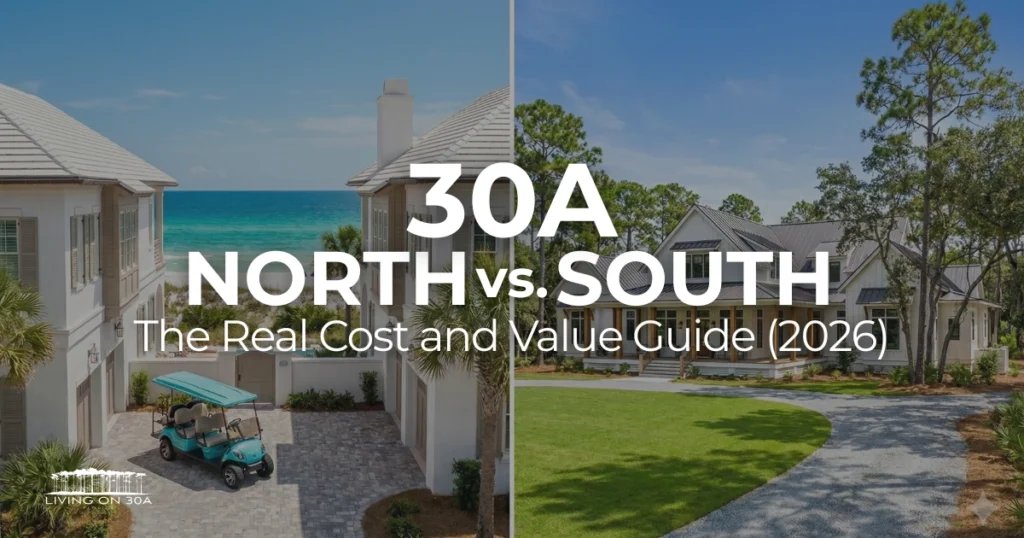
What matters is that the trips are productive. A weekend spent driving from Dune Allen to Inlet Beach with no filter is a vacation, not a search. If you have not yet sorted out the basic layout of the area, start with the geography of 30A before you look at a single listing. Understanding the real value differences between the south and north sides of 30A will eliminate more properties in an afternoon than any showing schedule.
Phase One: Narrowing Before You Book a Flight
This is where remote buying is won or lost. Everything you do before the trip determines whether the trip is worth taking.
What a Listing Photo Leaves Out on 30A
Photography on 30A is very good. That is the problem. A wide-angle lens and a drone at golden hour flatter almost everything, and there are specific things they consistently hide here.
Highway noise is the big one. Some homes sit close enough to Highway 98 that you hear it on the back porch, and no photo will tell you that. Neither will a photo tell you that the vacant lot beside the house is entitled for a five-bedroom rental with a pool, or that the “steps to the beach” access is a private HOA walkover you do not have rights to use.
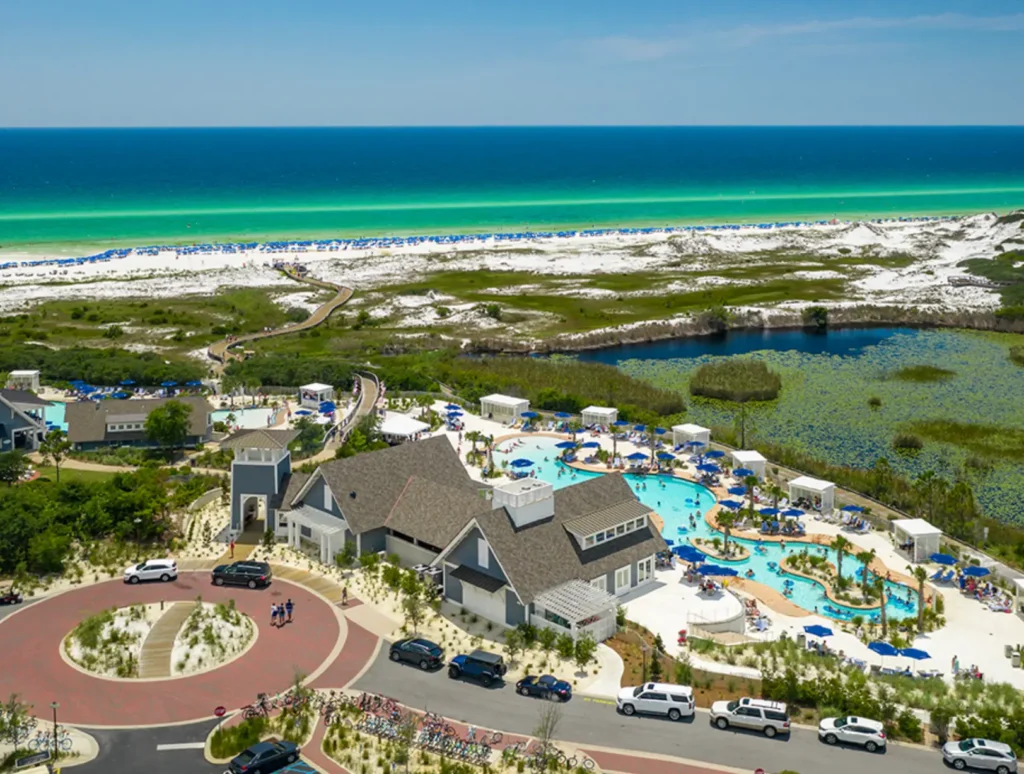
Beach access is the single most misrepresented item in 30A listings. Deeded access, HOA access, and public access are three different things with three different values, and listing copy blurs them constantly. Read the rules on public versus private beach access before you evaluate any property that claims proximity to the water.
Rental density is the other one. A street where nine of eleven homes are short-term rentals feels very different in July than the photos suggest. If your intent is a quiet primary residence, that matters enormously. If your intent is income, it may not matter at all.
Video Walkthroughs and Live Calls
There are two versions of a remote showing and they do different jobs.
The first is a live FaceTime call. I walk the house while you watch, and you ask questions in real time. This is the better tool when you already like a property and want to interrogate it. You can tell me to go back to the primary bath, open the utility closet, step outside and listen, or point the camera at the neighbor’s lot.
The second is a private YouTube video. I walk the house on my own, narrate what I am seeing, and send you an unlisted link. This is the better tool for volume and for spouses in different time zones. You watch it twice, you send it to your husband, you rewatch the parts that bothered you.
Neither one replaces standing in a house. Both of them keep you from wasting a trip on a house you would have eliminated in ninety seconds.
Understanding Communities Before You Arrive
Individual houses are easy to evaluate remotely. Communities are not, because a community is a set of rules, fees, and daily rhythms that no walkthrough captures.
That is most of why I create so much community-specific content across my blog, my YouTube channel, and social. It is faster and more honest for you to watch a full breakdown of a neighborhood than for me to summarize it on a call. If you are weighing the manicured east end, comparing Seaside and WaterColor for families or reading through the costs and rules of living in Rosemary Beach will tell you more than a drive-through would. If the ultra-luxury tier is on your list, the honest comparison of Rosemary Beach against Alys Beach covers the trade-offs most buyers do not learn until they are already under contract.
If you want the old Florida side instead, look at what living in Grayton Beach is actually like and how Seagrove and Grayton differ. Value-focused buyers usually end up reading Inlet Beach against Rosemary Beach at some point, because that comparison is really a question about what you are paying a brand for.
I am happy to drive a community and film it for you. I just want you to do the reading first, so the drive-through answers a specific question instead of starting from zero.
Phase Two: Making the Trip Count
When the list is down to four or five properties, come.
Stand in the Right Four Houses
Three days is enough if the list is right. Plan on seeing your short list, plus two or three properties I add that you would not have picked from photos. That second group matters more than people expect. Photos systematically undersell certain homes, particularly ones with dated interiors on excellent lots, and those are frequently the best buys on the board.
Do not schedule twelve showings a day. You will stop seeing anything after the fifth house.
Check the Things That Only Exist in Person
Drive the route from the house to the beach access at 4 p.m. on a Saturday. Stand in the backyard and listen. Walk the street. Look at what is under construction within two blocks.
Go back to your top property a second time on a different day, at a different hour. Morning light and evening light tell you different things, and traffic on 30A is a completely different animal at 10 a.m. than at 5 p.m.
When You Come Changes What You See
This is the part almost nobody accounts for. A February trip and a July trip show you two different markets and two different lifestyles.
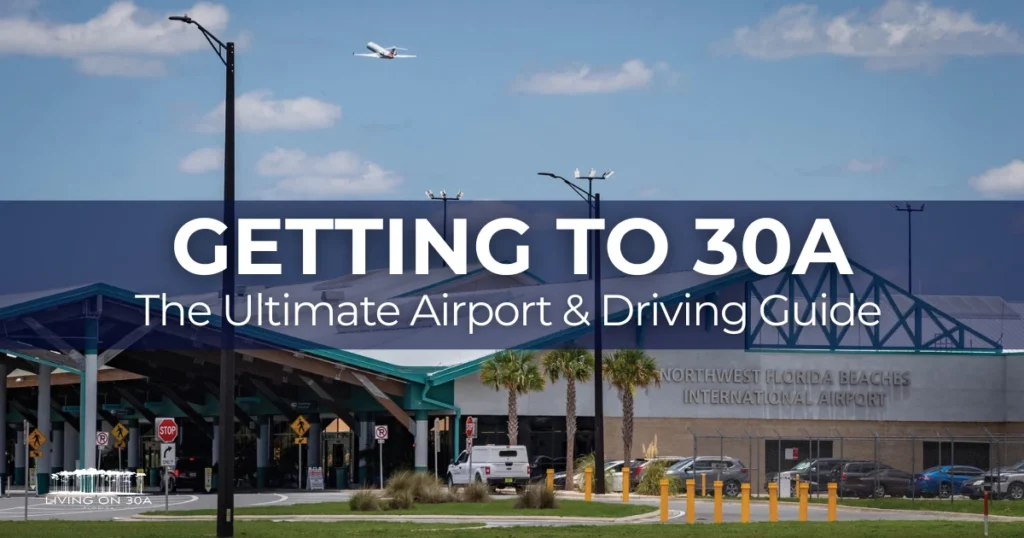
Off-season, you get access, unhurried showings, and an honest look at how quiet a neighborhood gets. Peak season, you get the traffic, the parking reality, and the rental turnover at full volume. Both are useful. Neither alone is complete. The seasonal breakdown of when to visit is worth reading before you pick your dates, and if you are flying, the comparison between ECP and VPS will save you a two-hour mistake.
Phase Three: Writing the Offer From a Distance
Nothing about writing an offer requires you to be in Florida. Everything is signed electronically.
Before we write anything, we sign a buyer representation agreement. That is a required step now, and it is signed remotely like everything else. I think it works in your favor. It puts in writing that I am accountable to you and not to the seller, which is the entire point of having someone here.
Earnest money. On 30A, 1% is what we typically see as an acceptable deposit. In competitive situations, buyers often offer more to strengthen the position. Your first wire happens here, which means your first wire fraud exposure happens here. More on that below, and it is not optional reading.
Inspection period. The Florida Realtors and Florida Bar “As Is” contract sets a default inspection period of 15 days. During that window you can cancel for any reason at your sole discretion and get your deposit back. Fifteen days is plenty even for out-of-state buyers, because the work is done by people on the ground, not by you. Many sellers here will counter asking for 10 days. That is normal and usually workable, but it compresses the schedule, so we line up the inspector before the offer goes out rather than after.
Financing. I keep a short list of lenders who understand second homes, jumbo loans, and out-of-state borrowers, and who close on time. I am happy to share it. The wrong lender on a remote purchase costs you an extension request and sometimes the deal.
Phase Four: Due Diligence Is Where Distance Costs People
This is the part buyers underestimate, and it is the part that protects you.
Somebody has to be physically in that house asking questions on your behalf and telling you what they found. Not forwarding you a PDF.
The Home Inspection
I do not attend every inspection start to finish. What I do is arrive at the end, walk the house with the inspector, and hear the findings directly from the person who just spent three hours in your attic and under your sinks.
That conversation is worth more than the report, because reports flatten everything into the same font. An inspector will tell you out loud which of the twenty-two items actually matter, and inspectors are far more candid in person than in writing.
Then when the written report arrives, we work through it together, informed by what he told me. If there is a lot to cover, we set up a call with you, me, and the inspector on the same line so you can ask him directly.
Wind Mitigation, Four Point, and Termite
These are insurance inspections, not condition inspections, and they exist to answer two different questions.
A four point inspection looks at roof, electrical, plumbing, and HVAC, and it largely determines whether a carrier will write a standard policy at all on an older home. A wind mitigation inspection documents hurricane-resistant construction features on a standardized state form, and Florida law requires carriers to discount the windstorm portion of your premium based on what it shows. On a coastal property, the windstorm portion is usually the largest slice of the bill, so those credits are real money.
Normally we use a single inspector who can handle all of it, including termite, in one visit. That is simpler to schedule and simpler for you.
Budget note that surprises people: inspections, wind mitigation, four point, and termite are out-of-pocket costs paid at the time of service. They do not roll into closing. A survey is the usual exception and is often rolled into closing costs.
Survey, Elevation, and Flood Zone
The survey shows you where the property lines actually are, whether the fence or the pool deck encroaches, and what easements exist. On 30A, easement and setback surprises are more common than you would think, particularly on older lots that have been subdivided or rebuilt.
Flood zone determination drives insurance and sometimes financing. Zones vary meaningfully within a few hundred feet here, and elevation matters. Much of Inlet Beach, for example, sits in Flood Zone X. Also worth understanding: hurricane coverage in Florida is generally a separate deductible built into a standard policy, typically calculated as a percentage of replacement cost, not a separate windstorm policy you go buy elsewhere.
HOA and Condo Documents Have Their Own Clocks
This is the deadline out-of-state buyers miss most often, because it runs independently of the inspection period.
If you are buying a condominium, Florida law gives you a review and cancellation right after you receive the association documents. That window was extended from three days to seven days effective July 1, 2025. If you are buying in a deed-restricted community governed by a homeowners association, the cancellation right after receiving the governing documents is three days.
Seven days and three days are not the same, and the clock starts on delivery, not on the day you get around to reading them. When you live two time zones away and the package lands in your inbox on a Friday afternoon, that difference is the whole ballgame.
Read them. Or tell me what you care about and I will read them and flag what will affect you. Rental restrictions are the most common landmine. Watersound Origins, as one example, carries a six-month minimum lease rule. For a full-time resident that is a feature. For an investor expecting weekly rentals, it kills the thesis. HOA structures vary enormously across communities, and understanding how WaterColor’s districts and fees are built or what Alys Beach ownership actually costs will show you how wide that range gets.
Rental History and Existing Bookings
If you are buying a home that currently operates as a short-term rental, ask for the rental history early. Not a projection from a management company. The actual history.
Then ask the separate question almost nobody asks: what happens to the bookings already on the calendar? Existing reservations do not disappear at closing. They have to be addressed in the contract, and the terms vary. You may be honoring rates that were set eighteen months ago. You may be inheriting a management agreement. You need to know before your inspection period expires, not after.
Phase Five: Insurance Before You Are Committed
Get a bindable insurance quote while you still have a contingency.
Not an estimate. Not a range from a friend. A quote from a carrier that has seen the four point and the wind mitigation report and is prepared to write the policy at a stated number.
Florida insurance is the single most common reason a good-looking 30A deal turns bad late. Buyers who wait until after the inspection period expires to shop coverage lose their leverage entirely, because at that point walking away costs them the deposit.
Order the insurance inspections at the same time as the home inspection. Get the quote in hand before the clock runs out. If the number is wrong, you still have the right to leave.
Phase Six: Closing Remotely in Florida
Closing from a distance is routine in Florida. There are three normal paths, and I have not needed to use a power of attorney in years because remote closings have gotten that easy.
| Method | What it looks like | What it requires | Best for |
|---|---|---|---|
| Remote Online Notarization (RON) | Live video session with a Florida commissioned notary, documents signed electronically | Camera, valid government ID, identity verification, and lender approval if you are financing | Most out-of-state buyers, including cash buyers |
| Mail-away closing | Documents overnighted to you, signed in front of a local notary, returned by courier | A local notary and a few extra days in the schedule | Buyers whose lender does not accept RON |
| Mobile notary | A notary travels to your home or office to witness the signing | Scheduling and a separate notary fee | Buyers who want an in-person signing without traveling to Florida |
One Florida quirk worth knowing so it does not surprise you: Florida still requires two subscribing witnesses on a deed under Section 689.01 of the Florida Statutes, and those witnesses may sign electronically over audio-video. It is mostly a seller-side issue, but it is part of why a Florida closing has more signature blocks than the one you did in Ohio.
The other variable is your closing agent. I work with a number of title companies, and the one I personally prefer is Rushing Law Firm. A closing agent who handles remote buyers routinely is not a small detail. It is the difference between a scheduled RON session and a scramble.
Protecting the Wire
Closing remotely is routine. Wire fraud is not, and this market is a target because the numbers are large.
The FBI’s Internet Crime Complaint Center logged 12,368 real estate fraud complaints and more than $275 million in losses in 2025. Business email compromise, the category that swallows most closing wire fraud, accounted for over $3 billion in reported losses, and the vast majority of that money moved by wire or ACH. Criminals are now using AI to write the emails, which means the old advice about watching for bad grammar is dead.
Three rules. They are not negotiable.
Call to verify, always, using a number you already have. Not the number in the email. Not the number in the signature block. A number you wrote down earlier from a source you trust. Confirm the account and routing numbers verbally before you send a dollar.
Never act on instructions that suddenly changed. Legitimate title companies do not email you at 4:45 p.m. on closing eve to say the wiring instructions have been updated. That message is fraud until proven otherwise, and it usually is.
Call the bank immediately if something feels wrong. Recovery is possible, but the window is measured in hours. The FBI’s recovery team froze a majority of the funds in the cases it caught in time. Time is the only variable you control.
This applies to your earnest money deposit too, not just the closing wire. The first wire is the one people relax about.
Owning From a Distance
The purchase ends. The distance does not.
Someone needs a key or a code. Not a neighbor you met once. A property manager, a caretaker, or a trusted contact who can be at the house within an hour when the alarm goes off or a pipe fails.
Property management fees run roughly 20% on 30A for short-term rental management, with meaningful variation by company and structure. Alys Beach is the outlier, with mandatory in-house rental management at a flat 40% and no opt-out. If you are underwriting income, use the right number for the specific community.
Short-term rentals require two registrations, not one. You need a Florida DBPR vacation rental license and a separate Walton County short-term vacation rental registration. Both must be in place before you advertise or rent, and your certificate number has to appear on your listings. Walton County’s renewal portal opens April 1 each year, and beginning with the 2026-2027 cycle, renewals are due before June 1 to align with the state licensing calendar. Missing a renewal while you are seven states away is an easy and expensive mistake.
Insurance, taxes, and utilities need addresses that reach you. Set them up correctly at closing rather than chasing forwarded mail in October.
If this is going to become your full-time home eventually, the realities of living on 30A year-round and the relocation logistics of schools, internet, and utilities are worth reading well before you make the move.
Where Remote Buying Goes Wrong
I would rather tell you the failure modes than sell you the process.
Buying fully sight unseen. It can be done. I have done it. But I will tell you plainly: if you have never set foot on 30A, I do not want you buying here without coming first. Not because the house will surprise you, but because the lifestyle might. People fall in love with the idea of 30A and discover they wanted something quieter, or busier, or two miles further west. That is a very expensive thing to learn after closing.
Compressing due diligence to save a trip. Waiving inspections to win a competitive offer is a decision, not a strategy. From a distance, it is a bad one.
Treating the HOA documents as paperwork. They are the rules you will live under and rent under for as long as you own the property.
Hiring someone who is not accountable to you. The listing agent is not your advocate. That is not an insult to them, it is their job. When you are 900 miles away, having your own representation is not a formality.
You do not have to be here to buy. You do have to have someone here who is accountable to you.
Frequently Asked Questions
Can I buy a home on 30A without ever seeing it in person?
Legally and logistically, yes. Video walkthroughs, remote inspections, and online notarization make a fully sight-unseen purchase possible, and it happens on 30A regularly. I still recommend against it for a first purchase here. The house is the easy part to verify remotely. Whether a specific stretch of 30A fits how you actually want to live is the part that requires standing there.
Do I have to be in Florida to close on a 30A home?
No. Florida has allowed remote online notarization since 2020, so you can sign and notarize your closing documents over a secure video session from anywhere. Mail-away closings and mobile notaries are also standard options. If you are financing, confirm early that your lender accepts remote online notarization, because lender approval is required and finding out late creates a scramble.
If I buy a 30A home that is already a rental, do I inherit the existing bookings?
Usually yes, and it has to be handled in the contract rather than assumed. Reservations on the calendar at closing do not automatically cancel, which means you may be honoring rates set a year or more ago and possibly stepping into an existing management agreement. Ask for the booking calendar and the management contract during your inspection period, while you still have the right to walk.
Let’s Map Out Your Trip Before You Book It.
If you are searching 30A from another state, the most valuable thing I can do is help you eliminate properties before you spend a flight on them. Tell me what you are trying to solve for and I will tell you honestly which communities fit and which ones do not. No pressure, no pitch, and no obligation to buy anything.
Call or Text: 850-585-0642 or email: andy@livingon30aflorida.com