

What Is It Really Like Living in Rosemary Beach?
Living in Rosemary Beach means owning property in a master-planned New Urbanist community governed by the Rosemary Beach Pattern Book and DPZ Architects. Typical annual ownership costs for a $2M single-family home range from $31,800 to $59,600 beyond the mortgage, covering HOA dues ($400-$800/month), layered wind and flood insurance ($12,000-$25,000), and accelerated coastal maintenance.
Cost at a Glance: Annual Ownership Budget
Cost Snapshot: The “Hidden” Fees (Estimates based on a typical $2M Single-Family Home)
| Expense Category | Estimated Cost | Frequency | Notes |
| Transfer Fee | $20,000 | One-Time | 1% of purchase price paid at closing. |
| HOA Dues | $400-$800 | Monthly | Covers common areas, security, basic cable. |
| Insurance (Wind/Flood) | $12,000-$25,000 | Annually | Required separate policies for ZoneA/ |
| Deferred Maintenance | $15,000-$25,000 | As Needed | Salt air accelerates HVAC, roof, and exterior paint cycles. |
Total Annual Carrying Cost (excluding mortgage): $31,800 – $59,600+ for typical $1.5M – $2.5M properties.
Note: These figures represent baseline costs. Actual expenses vary based on property size, location within Rosemary Beach, rental activity, and deferred maintenance needs.
The Rosemary Beach Design Code: Why It Looks This Way
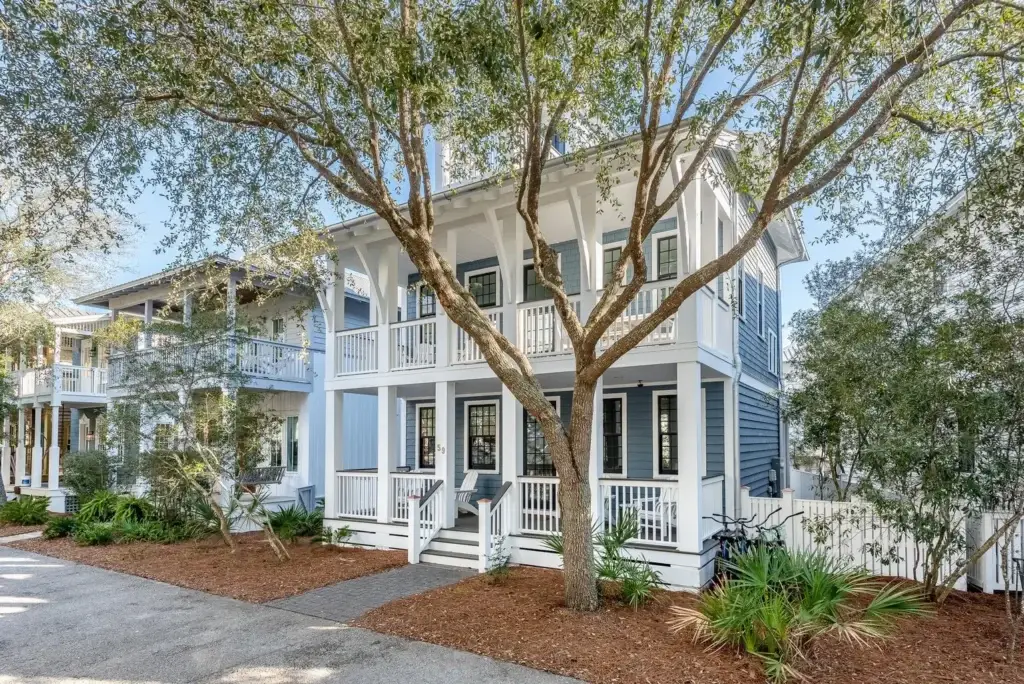
What visitors perceive as “charming” or “quaint” is actually the product of rigorous architectural enforcement. Rosemary Beach was master-planned by Andres Duany and Elizabeth Plater-Zyberk (DPZ), pioneers of New Urbanism who designed the town as a controlled density experiment. For context on where Rosemary Beach sits within the corridor, see our complete 30A guide. The aesthetic is not organic—it’s legislated through the Pattern Book, a binding document that governs every building detail from window proportions to paver materials.
The 12 Building Types
Unlike conventional subdivisions where homeowners select from builder floor plans, Rosemary Beach restricts all construction to 12 predefined building types. Each type has specific lot requirements, setback rules, and architectural parameters:
- The Arcade – Mixed-use buildings with ground-floor retail and upper residential
- The Flats – Three-story multi-family structures with individual entrances
- The Courtyard House – Inward-facing residences organized around central courtyards
- The Rear Yard House – Traditional single-family with private rear gardens
- The Side Yard House – Narrow-lot configuration with side access
- The Tower House – Vertical living with rooftop terraces
- The Pavilion – Open-air structures for community gathering
- The Carriage House – Detached accessory dwelling above garage
- The Cottage – Small-footprint single-family on compact lots
- The Estate House – Larger single-family on premium parcels
- The Townhouse – Attached multi-story with shared walls
- The Live-Work Unit – Ground-floor commercial with residential above
Each building type comes with non-negotiable specifications. You cannot, for instance, build a Rear Yard House on a lot zoned for Flats, regardless of personal preference or budget. Knowing your lot’s assigned building type is crucial before purchasing, as you cannot build a “Main House” on a lot zoned for a “Cottage.” This restriction surprises buyers who assume property ownership grants design freedom.
Specific Architectural Requirements
The Pattern Book mandates granular construction details that create visual cohesion but limit individual expression:
- Deep eaves with minimum 24-inch projection to manage sun and rain
- Exposed rafter tails (no enclosed soffits in many applications)
- Vertically proportioned windows (typically 1:2 or 1:1.5 ratios, rarely horizontal)
- Stucco over masonry or wood siding (vinyl, fiber cement, and metal panels prohibited in most applications)
- Standing seam metal roofs or clay tile (asphalt composition shingles banned)
- True divided light windows or simulated divided lights with interior and exterior muntins
- Specified paint colors from an approved palette (custom colors require ARB variance)
These requirements drive up construction costs substantially. Stucco over masonry construction—the dominant method here—costs 30-40% more than wood-frame with synthetic stucco (EIFS) common in conventional Florida developments.
The “Urban” Feel: Density by Design
Rosemary Beach’s walkability stems from intentional density that creates what urban planners call the “outdoor room” effect. Buildings sit close to streets with minimal front setbacks, defining public space through architecture rather than lawns. This produces the European-style streetscape but reduces residential privacy substantially.
Houses are closer together than most buyers expect. The masonry party walls in townhouses and flats transmit less sound than wood framing, but the narrow spacing between detached structures (sometimes 10 feet or less) means neighbor conversations on balconies are clearly audible. The alleys—designed for service access and garage entries—run directly behind properties, putting trash collection, delivery vehicles, and pedestrian traffic within feet of bedroom windows.
This density is the foundation of walkability, but represents a significant lifestyle adjustment for buyers accustomed to suburban lot sizes. Buyers weighing the real value differences south vs north of 30A should factor density expectations into that decision. There is no “private backyard BBQ” experience here—outdoor spaces are either tiny courtyards or shared semi-public plazas. Buyers who prioritize space over walkability may find living in Grayton Beach a better fit, with larger lots and a laid-back Old Florida character.
The Real Cost of Ownership (Beyond the Mortgage)
Purchase price represents only the entry fee. Ongoing ownership in Rosemary Beach involves cost layers that most listing agents underexplain. Buyers looking at nearby alternatives should compare the Inlet Beach vs Rosemary Beach breakdown for a value perspective.
Maintenance: The Salt Air Tax
Coastal construction 400 yards from the Gulf means accelerated deterioration of every building system:
- HVAC replacement cycles: 8-12 years versus 15-20 inland. Salt air corrodes condenser coils and requires more frequent compressor replacement. Budget $8,000-$15,000 per system.
- Metal roof maintenance: Standing seam roofs need fastener inspection and sealant refresh every 5-7 years. Full replacement at 25-30 years runs $25,000-$45,000 depending on building type.
- Exterior paint: Stucco over masonry requires repainting every 6-8 years due to UV exposure and salt degradation. Professional repainting of a typical three-story townhouse: $12,000-$18,000.
- Window and door seals: Coastal wind and humidity require replacing weatherstripping and caulking every 3-5 years to prevent water intrusion.
Many owners underestimate the cumulative effect. A $1.2 million townhouse should budget $15,000-$25,000 annually for deferred maintenance reserves beyond routine upkeep.
HOA & Fees
Rosemary Beach HOA dues vary by property type but generally run $400-$800 monthly for single-family homes, covering common area maintenance, landscaping, security, and amenity access. Additional assessments include:
- Transfer Fee: 1% of purchase price paid by buyer at closing (on a $2 million property, that’s $20,000)
- Capital Contribution Fee: One-time fee for new construction or major renovation, ranging $5,000-$25,000 depending on project scope
- Amenity Passes: While basic pool access is included, premium amenities like boat slips and fitness center access often require separate fees ($500-$2,000 annually)
- Special Assessments: Infrastructure upgrades (roads, drainage, utilities) are periodically assessed to all owners
Insurance: The Florida Panhandle Reality
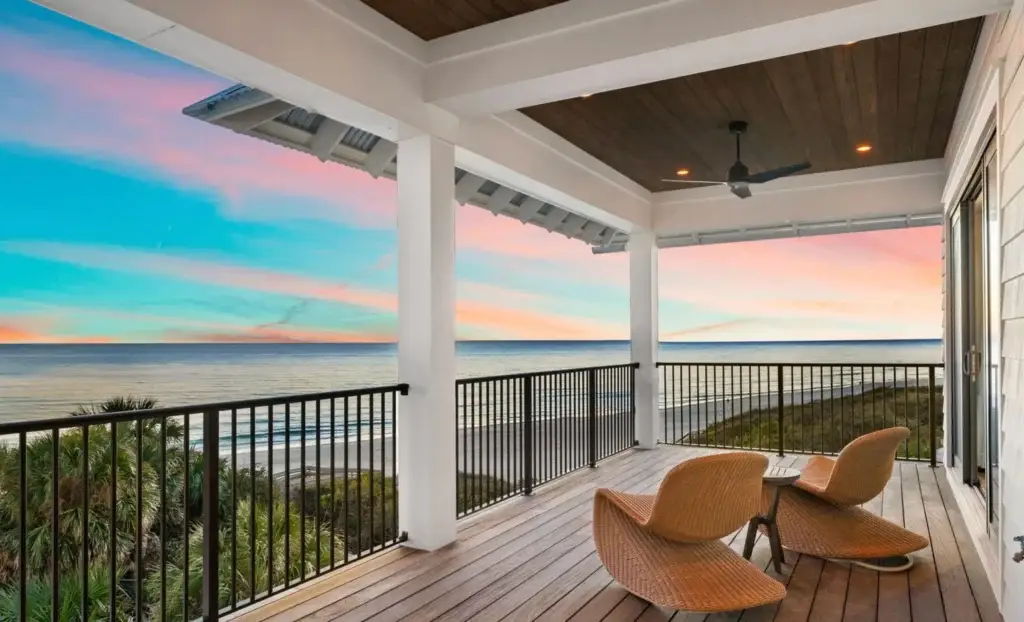
Standard homeowners insurance doesn’t cover wind damage in coastal Zone A flood areas. Rosemary Beach properties require layered policies:
- Flood Insurance: NFIP policies max out at $250,000 for structure and $100,000 for contents—inadequate for homes valued over $1 million. Excess flood coverage through private insurers adds $3,000-$8,000 annually.
- Wind/Hurricane Coverage: Separate windstorm policy through Citizens or surplus lines carriers. Annual premiums of $8,000-$15,000 are common for properties valued at $1.5-$2.5 million.
- Umbrella Liability: Essential given short-term rental exposure. $2-5 million coverage runs $800-$1,500 annually.
Total annual insurance costs of $12,000-$25,000 are typical for properties in the $1.5-$3 million range—substantially higher than inland Florida properties. These insurance layers apply across the corridor, but coastal Zone A properties like Rosemary Beach sit at the high end. Understanding beach access rules on 30A helps clarify which properties carry this exposure.
Compliance Costs: The Architectural Review Board
The Architectural Review Board (ARB) must approve any exterior modification, no matter how minor. This includes:
- Paint color changes (even repainting in the same color requires submittal)
- Fence installation or modification
- Landscape changes beyond routine maintenance
- Light fixture replacement
- Shutter addition or removal
- Satellite dish or solar panel installation
Each ARB submittal requires drawings prepared by a licensed design professional. Even simple projects (replacing a front door, adding window boxes) involve $500-$1,500 in architectural fees before a single hammer swings. Major renovations requiring engineered drawings can accumulate $15,000-$35,000 in design and compliance costs before construction begins.
The ARB meets monthly and commonly requests revisions, extending timelines by 60-90 days. Owners accustomed to making quick property decisions find this process frustrating.
Investment Potential: Rental Rules & ROI
The Carriage House model—a detached accessory dwelling above a garage—is central to Rosemary Beach’s density strategy and many owners’ financial models. In theory, renting the carriage house offsets ownership costs. In practice, logistics are more complex.
The Friction of Shared Space
A carriage house rental means strangers accessing your property weekly or bi-weekly throughout peak season (March-October). Practical implications include:
- Luggage noise: Wheels on brick pavers and cobblestone alleys create significant sound, especially during 4 PM check-ins and 10 AM checkouts
- Shared driveways: Renters frequently block garage access or park incorrectly, requiring owner intervention
- Garbage management: Coordinating trash schedules and preventing overflow when both units are occupied
- Guest questions: Renters treat owners as de facto concierge, asking about restaurant recommendations, beach access, and troubleshooting rental equipment
Many owners solve this by hiring property management companies, which typically charge 20-30% of gross rental revenue plus flat fees for cleanings, inspections, and maintenance coordination.
Parking Wars: The Alley-Loaded Reality
Rosemary Beach’s alley-loaded garage system theoretically keeps cars off streets and maximizes walkability. In practice, garages become storage for owner belongings—bicycles, beach equipment, golf carts, seasonal furniture—forcing renters to park on narrow streets with limited spaces.
During peak season (Memorial Day through Labor Day), street parking is scarce. Renters circle blocks searching for legal spaces, often parking illegally and receiving citations. This generates negative reviews and owner headaches. The Pattern Book’s requirement for permeable surfaces means no asphalt parking pads can be added to relieve pressure.
Owners serious about rental income must keep garages clear and functional, requiring off-site storage units ($150-$300/month) or ruthless minimalism.
Rental Rules: HOA Constraints
Short-term rental is permitted but regulated:
- Minimum stay requirements: Typically 7 nights during summer peak season, 3-5 nights off-season (varies by specific property deed restrictions)
- Occupancy caps: Strictly enforced based on bedrooms and square footage. Exceeding limits results in fines ($500-$1,000 per violation).
- Registration requirement: All rental properties must register with the HOA and provide emergency contact information
- Noise ordinances: Quiet hours (10 PM – 8 AM) are actively enforced through security patrols and neighbor complaints
- Guest behavior liability: Owners are responsible for renter violations of community rules
The HOA can and does suspend rental privileges for repeat violations, eliminating income streams that owners may be relying on to service mortgages. Rental rules vary significantly across 30A communities. Our WaterColor vs Watersound comparison breaks down how neighboring communities handle short-term rental restrictions differently.
Financial Reality Check
Gross rental income for a two-bedroom carriage house runs $30,000-$60,000 annually depending on location and finish quality. After property management fees (25%), cleaning costs ($150-$200 per turnover × 20-30 turnovers), maintenance reserves, increased insurance, and occupancy taxes, net income typically lands at $15,000-$35,000. This is meaningful but rarely covers the full cost of ownership when mortgage, insurance, HOA fees, and maintenance are totaled.
Landscaping & The Environment: It’s Not Just “Gardens”
The lush, seemingly casual vegetation is precisely engineered to meet environmental regulations and Pattern Book standards.
Permeable Surfaces: No Asphalt Allowed
All hardscape must allow water infiltration to manage stormwater runoff and prevent overtaxing the town’s drainage infrastructure. This means:
- Brick pavers set in sand (not mortar) for driveways, patios, and walkways
- Crushed shell or gravel for secondary pathways
- Permeable concrete pavers in limited applications
Standard asphalt or concrete driveways are prohibited. While permeable pavers create attractive streetscapes, they require more maintenance. Sand joints between pavers need periodic refilling, bricks shift and require re-leveling, and weed control is ongoing. Budget $800-$1,500 annually for professional paver maintenance on typical lot sizes.
Native Plants: The Approved Species List
The Pattern Book includes an Approved Species List emphasizing native and salt-tolerant plants:
- Scrub Oak (Quercus geminata)
- Saw Palmetto (Serenoa repens)
- Muhly Grass (Muhlenbergia capillaris)
- Beach Sunflower (Helianthus debilis)
- Rosemary (Conradina canescens)
Expansive turf lawns are discouraged through irrigation restrictions and maintenance requirements. Most properties feature courtyard gardens with dense plantings rather than traditional grass yards. This reduces water consumption but requires specialized landscape maintenance. Finding contractors familiar with native plant care and willing to work within Rosemary Beach’s service constraints (narrow alleys, limited equipment access) narrows the vendor pool and increases costs.
Dune Protection: The Coastal Construction Control Line
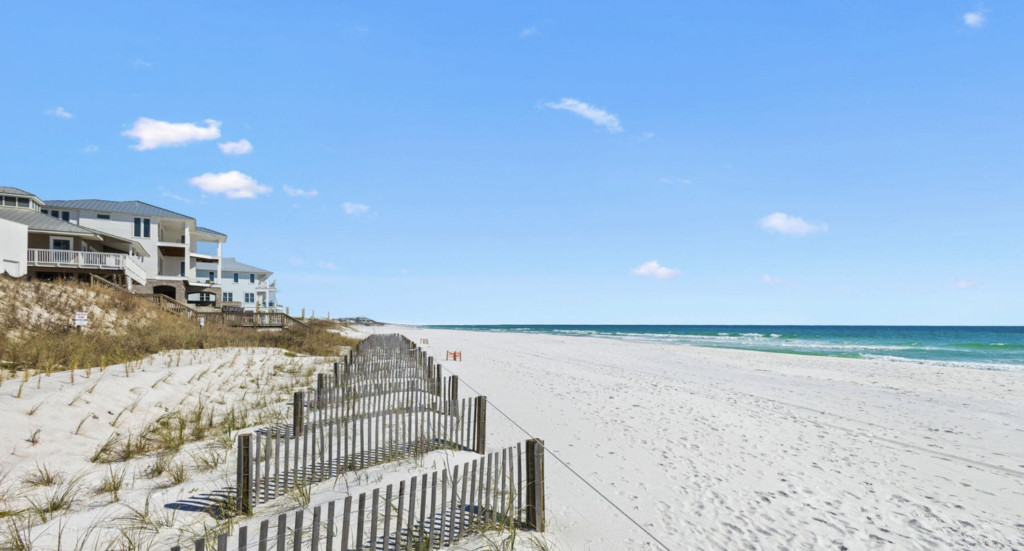
Properties near the Gulf encounter the Coastal Construction Control Line (CCCL), a state-regulated boundary that restricts construction seaward of established dunes. Implications include:
- Pool placement limitations: Pools, decks, and permanent structures cannot extend into CCCL zones without extensive permitting (often denied)
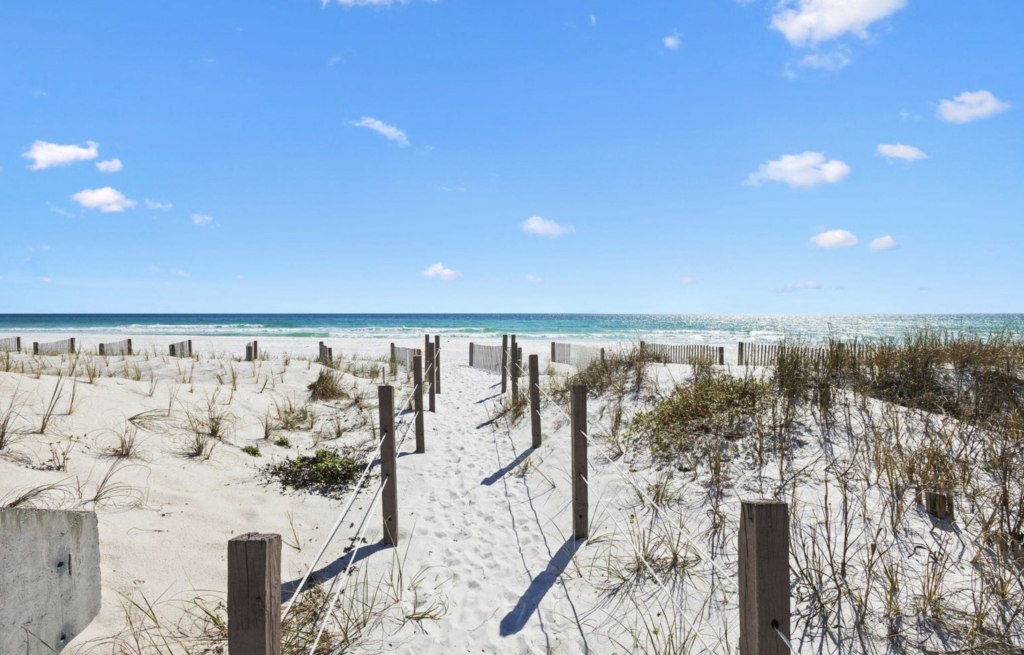
- Dune walkover requirements: Beach access must use elevated walkovers to prevent dune erosion—no at-grade paths allowed
- Vegetation restrictions: Dune areas require native grasses and shrubs; removing or altering dune vegetation requires permits and restoration plans
Buyers expecting to maximize beachfront lot usage discover these restrictions reduce buildable area significantly. A $4 million beachfront lot may have 30-40% of its depth restricted from development.
The “Resort vs. Resident” Friction
Living in a tourist destination creates daily friction points rarely discussed in marketing materials.
Noise Transfer: Masonry Acoustics
The predominant stucco over masonry construction provides excellent fire resistance and hurricane protection but reflects sound rather than absorbing it. Vertical three-story buildings in narrow alleys create acoustic canyons. Common noise sources include:
- Early morning trash collection: Commercial dumpsters emptying at 6:30 AM reverberate between buildings
- Delivery vehicles: Food service, linen service, and package delivery trucks navigate alleys throughout the day
- Guest activity: Rental turnover days (Fridays and Saturdays in summer) mean constant luggage rolling, door slamming, and vehicles idling
- Restaurant exhaust systems: Commercial kitchen ventilation runs late into evenings for adjacent residential units
Noise-sensitive buyers should avoid properties adjacent to Town Center commercial spaces or on alleys serving multiple rental properties.
The “Bubble” Effect: Limited Services On-Site
Rosemary Beach contains restaurants, a small market, and beach amenities, but lacks infrastructure for daily life:
- No grocery store: The nearest Publix is 4 miles east on Highway 98
- No pharmacy: CVS and Walgreens require a drive to Highway 98
- No hardware store: Home improvement needs mean trips to Santa Rosa Beach or Destin
- Limited medical facilities: No urgent care on-site. Serious medical needs require transport to Sacred Heart Hospital in Miramar Beach (20 minutes) or Fort Walton Beach (35 minutes).
- Proximity to airports and regional services is covered in our guide to getting to 30A.
This necessitates vehicle ownership despite walkability marketing. Most residents maintain at least one car for off-site errands, negating some of the pedestrian-oriented lifestyle benefits. For a full breakdown of nearby services, schools, and infrastructure, see our full 30A relocation guide.
Seasonality: The Off-Season Reality
Many restaurants and shops adjust hours or close entirely November through February. Favorites like Restaurant Paradis may reduce days of operation, and some boutiques close for weeks at a time. Year-round residents find themselves driving to neighboring communities for dining and shopping variety during slow months. Our guide to what it’s really like living on 30A full-time covers the off-season realities across the corridor.
The town’s character shifts dramatically between summer (vibrant, crowded, energetic) and winter (quiet, intimate, but limited). Buyers seeking consistent year-round energy may find off-season isolation disappointing.
Service Bottlenecks: The “Rosemary Premium”
Contractors, plumbers, electricians, and service providers charge premium rates for Rosemary Beach work, often 20-30% above rates for surrounding communities. Contributing factors include:
- Access constraints: Narrow alleys and limited parking increase job difficulty
- ARB compliance requirements: Tradespeople must navigate architectural review documentation
- Peak season deprioritization: During summer, contractors prioritize larger commercial projects over small residential jobs
Emergency repairs (AC failures in July, plumbing leaks during rental season) command premium rates and slow response times. Owners without established contractor relationships face frustration and inflated costs.
Dining & Social Design
Rosemary Beach’s restaurant scene is central to the lifestyle proposition but comes with practical considerations beyond menu descriptions.
The “High Season” Crush
Prime dining spots like Pescado Seafood Grill & Rooftop Bar and Restaurant Paradis become nearly inaccessible to walk-in diners Memorial Day through Labor Day. Reservations for weekend dinners at Pescado often book 2-3 weeks in advance. Knowing the best (and worst) times to visit 30A helps set realistic expectations for seasonal dining access.
The alternative is driving to neighboring communities like Seaside, Alys Beach, or WaterColor where reservation pressure is marginally lower but eliminates the walk-home convenience that defines Rosemary Beach’s appeal.
Dress Codes: Specific Requirements
Restaurants enforce dress codes that surprise casual visitors:
- Pescado requires “resort casual” attire for dinner service—no swimwear, tank tops, or flip-flops
- Restaurant Paradis expects elegant dining attire consistent with fine dining standards
- Edwards Fine Food & Wine maintains upscale casual expectations during dinner service
- La Crema Tapas & Chocolate expects collared shirts for men during evening hours
- Onano (rooftop sushi) maintains similar standards
Residents accustomed to beach-casual lifestyles find themselves maintaining separate wardrobes for on-site dining versus home comfort.
Rooftop Logistics: Views vs. Accessibility
Multiple restaurants feature rooftop seating with Gulf views (Pescado, Onano, Vue on 30A). While visually appealing, these spaces present challenges:
- Stair-only access: No elevators, creating accessibility issues for elderly guests or those with mobility limitations
- Weather exposure: Summer afternoon thunderstorms frequently close rooftop sections without warning
- Heat factor: Even with fans and shade structures, July and August rooftop dining is uncomfortable before sunset
Savvy residents treat rooftop dining as an October-May experience and opt for ground-level venues during summer peak.
FAQs: Living in Rosemary Beach
1. Is Rosemary Beach a private community?
Rosemary Beach operates as a private community with important distinctions. The Town Center, including restaurants, shops, and commercial areas, is open to the public with no gate access required. However, beach access, pools, and residential amenities are strictly gated and coded for residents and registered guests only. Beach walkovers require access codes that change quarterly. Residential streets are privately owned, and while often accessible during daytime hours, the community can restrict access during high season or at night.
2. How much does it cost to live in Rosemary Beach?
Total annual carrying costs for a typical $1.5M to $2.5M property in Rosemary Beach range from $31,800 to $59,600 beyond the mortgage. That includes HOA dues ($400 to $800 per month for single-family homes), layered wind and flood insurance ($12,000 to $25,000 annually), and deferred maintenance reserves ($15,000 to $25,000 annually) driven by salt air deterioration. Buyers should also budget for the one-time 1% transfer fee at closing, which adds $20,000 on a $2M purchase.
3. Are short-term rentals allowed in Rosemary Beach?
Yes, short-term rentals are permitted in Rosemary Beach but face strict HOA regulation. Minimum stays are typically 7 nights during summer peak season and 3 to 5 nights in the off-season, though specific deed restrictions vary by property. Occupancy caps are enforced based on bedrooms and square footage, with fines of $500 to $1,000 per violation. All rental properties must register with the HOA, and the HOA can suspend rental privileges for repeat violations.
Final Note for Prospective Residents
Living in Rosemary Beach requires understanding that architectural beauty and walkable urbanism come with trade-offs. Buyers comparing luxury options should also read our Rosemary Beach vs Alys Beach comparison for a direct side-by-side. The town functions best for buyers who value design integrity and pedestrian lifestyle over suburban privacy and convenience, who have financial cushion for premium maintenance costs, and who can either embrace or effectively manage the short-term rental ecosystem. For buyers drawn to the luxury end of 30A but wanting a different feel, our guide to living in Alys Beach offers a direct comparison point.
Considering Rosemary Beach?
I help buyers navigate the design codes, HOA realities, and true ownership costs along 30A. Book a discovery call and let’s talk through whether Rosemary Beach fits your goals.


Pingback: The Real 30A Florida Guide: Towns, Truths & East vs. West
Pingback: Getting to 30A: Closest Airports (ECP vs VPS) & Driving Routes
Pingback: South of 30A vs. North of 30A: Real Costs, Value & Data (2026)
Pingback: Living in Alys Beach FL: The Ultimate Luxury Guide (2026 Costs & Rules)
Pingback: Rosemary Beach vs. Alys Beach: 2026 Cost & ROI Guide
Pingback: Moving to 30A: Relocation Guide (Schools, Internet & Utilities)