

Choosing between Rosemary Beach and Alys Beach is one of the most consequential decisions a luxury buyer can make on 30A. These two communities sit within a mile of each other on the eastern corridor, yet they deliver fundamentally different ownership experiences. This Rosemary Beach vs. Alys Beach comparison cuts through the brochure language and lays out the real numbers on HOA fees, rental management structures, insurance costs, and long-term hold value.
The Core Difference Between Rosemary Beach and Alys Beach
Rosemary Beach is a high-density, European-style village with flexible rental management options and wood-frame construction. Alys Beach is a lower-density, fortress-grade concrete community with stricter architectural covenants, higher HOA fees, and genuine acoustic privacy. The trade-off is cash flow control and social energy versus architectural durability, quiet, and exclusivity.
Both communities occupy the same luxury price tier, yet they attract very different buyers. If you are still getting oriented to the eastern end of the corridor, our complete 30A guide covers how this stretch fits into the broader geography before you dig into either neighborhood specifically.
At a Glance: How Rosemary and Alys Compare
Before the deep dive, here is where each community lands on the factors that matter most to luxury buyers:
- Best for Cash Flow: Rosemary Beach. Flexible rental management keeps more revenue in your pocket.
- Best for Long-Term Asset Durability: Alys Beach. Concrete ICF construction is a fundamentally different asset class than wood-frame.
- Best for Families: Rosemary Beach. The village energy, bike culture, and walkable main street are built for it.
- Best for Privacy: Alys Beach. Walled courtyards, lower density, and strict access control.
- Critical Management Difference: Rosemary Beach owners can typically choose their own property manager (15–25% fees). Alys Beach requires all STR owners to use its in-house rental management program at a mandatory flat 40% fee. There is no opt-out.
The Financial Reality: Rental Management and Net ROI
Most 30A comparison articles ignore the math. Here is what luxury investors actually need to know.
Rosemary Beach: Flexible Management, Higher Net Yield
In Rosemary Beach, property owners typically have the freedom to choose their own property management company. This means you can negotiate rates as low as 15–25% of gross rental income depending on the services provided. For a property generating $150,000 in annual rental revenue, that is the difference between keeping $112,500 at a 25% fee versus the net you would clear under a 40–50% split.
The brand recognition of Rosemary Beach drives consistently high occupancy, and the community sits at the center of the best time to visit 30A window, April through Labor Day, when demand along the entire corridor reliably outpaces inventory.
For a useful parallel on how managed rental structures affect net ROI at a comparable price point elsewhere on 30A, the living in WaterColor guide covers how St. Joe’s community management model plays out for owners there.
Alys Beach: Premium Rates, Captive Management Program
When analyzing Alys Beach rental economics, the nightly rate ceiling is real: $1,500–$3,000+ per night depending on property size and position. The complication is the management structure. Alys Beach requires all owners who wish to rent their property as a short-term rental to use its in-house rental management program. The fee is a flat 40% of gross rental revenue, with no opt-out for independent management.
After fees, your net return percentage at Alys may be lower than Rosemary despite the premium nightly positioning. For investors focused purely on cash flow, this is the most important distinction in this entire comparison. Alys is a lifestyle investment first and an ROI play second.
Insurance and the Hidden Cost of Construction Type
This is where Alys Beach pulls ahead in long-term total cost of ownership, and where most buyers fail to run the actual math.
Unlike Alys Beach, which uses Insulated Concrete Form (ICF) construction throughout, Rosemary Beach consists primarily of wood-frame construction. In Florida’s coastal insurance market, that distinction is expensive. Annual premiums for a $3M Rosemary Beach property typically run $12,500–$16,000, and that number tends to climb at renewal.
Alys Beach homes are built to withstand Category 5 hurricane conditions. Many properties have pursued FORTIFIED Home certification through the Insurance Institute for Business and Home Safety, which can significantly reduce insurance premiums depending on coverage structure and carrier. Over a 10-year hold, even that more modest savings compounds meaningfully and further narrows the total cost gap between the two communities.
HOA Fees and What They Actually Cover
This is among the most common questions buyers ask, and the gap between these two communities is significant.
Rosemary Beach HOA fees currently run approximately $6,000 per year for single-family homes and climb to $20,000 or more annually for condo properties, covering the town green, four neighborhood pools, beach walkover access, and community maintenance. Capital assessments and reserve contributions add additional cost on top of the base dues.
Alys Beach HOA fees are substantially higher: approximately $14,000 per year for single-family homes and $26,000 or more annually for condo properties. This covers the Caliza Pool complex, the Zuma wellness center, and meticulous common area maintenance. These are not optional. The fees fund the brand premium you are buying into.
The question is not which is more expensive. It is whether the premium is justified for your use case. For full-time residents or high-frequency users, Alys amenities may represent genuine value. For investors who are rarely on property, paying $12,000 in annual HOA fees while also managing rental splits is a materially different calculation.
For a full cost breakdown at the individual property level, see the dedicated living in Rosemary Beach guide and the living in Alys Beach guide.
Construction Quality and Long-Term Maintenance
Rosemary Beach: Dutch West Indies Charm, Higher Upkeep
Rosemary’s architecture, with its deep eaves, wood siding, and carriage house details, requires ongoing maintenance. In the salt air and humidity of the Gulf Coast, budget for the following on a routine basis:
- Full exterior repainting every 5–7 years ($15,000–$30,000 depending on property size)
- Wood rot remediation on eaves, trim, and decking (ongoing annual cost)
- Termite mitigation and annual inspections (required by most lenders in Florida)
These are not worst-case scenarios. They are baseline expectations for wood-frame construction a few hundred yards from salt water. The Rosemary Beach Architectural Review Committee enforces design standards aggressively, which keeps the neighborhood beautiful but means deferred maintenance will trigger compliance notices.
Alys Beach: Concrete Fortress, Minimal Maintenance
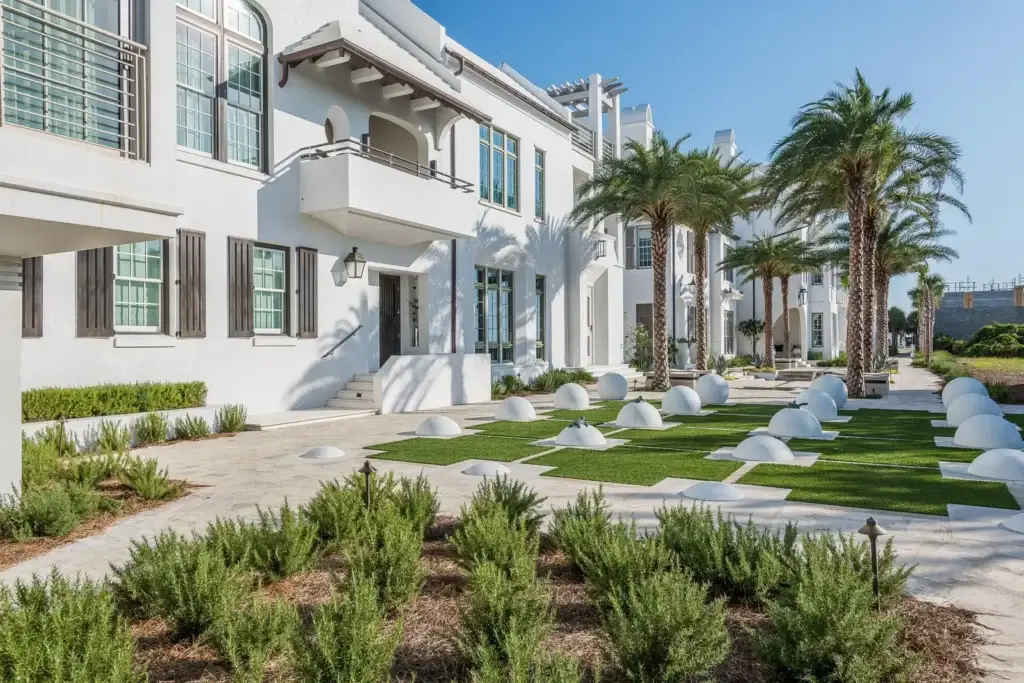
Alys Beach’s stark white stucco-over-concrete exteriors are virtually maintenance-free by comparison. No repainting (the white is integral to the stucco itself), no wood rot, no termite risk in solid concrete walls. The trade-off is strict architectural covenants. Changing anything visible from the street, including landscaping, courtyard walls, or outdoor furniture in some cases, requires Architectural Review Committee approval. The community maintains aesthetic uniformity with an iron fist.
The concrete construction also means you are buying an asset that should be standing in comparable condition in 50–100 years. For buyers thinking about generational wealth and legacy holds, this matters enormously. The south vs. north of 30A value breakdown is worth reading alongside this section for context on how construction type intersects with property value trends across the corridor.
Soundproofing, Privacy, and Noise Reality
This factor matters more than most buyers realize during a showing, and it rarely appears in comparison articles.
Alys Beach’s concrete construction creates genuine acoustic separation. You will not hear your neighbors, even in attached courtyard homes. The mass of the walls delivers real privacy in a way that no wood-frame construction can replicate.
Rosemary Beach is a different experience. Homes sit close together, often 10–15 feet of separation, with standard wood-frame construction between them. You will hear kids on bikes at 7 AM. You will hear the dinner party next door. You will hear the family upstairs if you are in a carriage house unit. That communal character is part of the appeal for many buyers and a dealbreaker for others. Know which camp you are in before you write an offer.
The Real Vibe: What the Brochures Won’t Say
Rosemary Beach: Village Energy, Family Chaos, and No Quiet
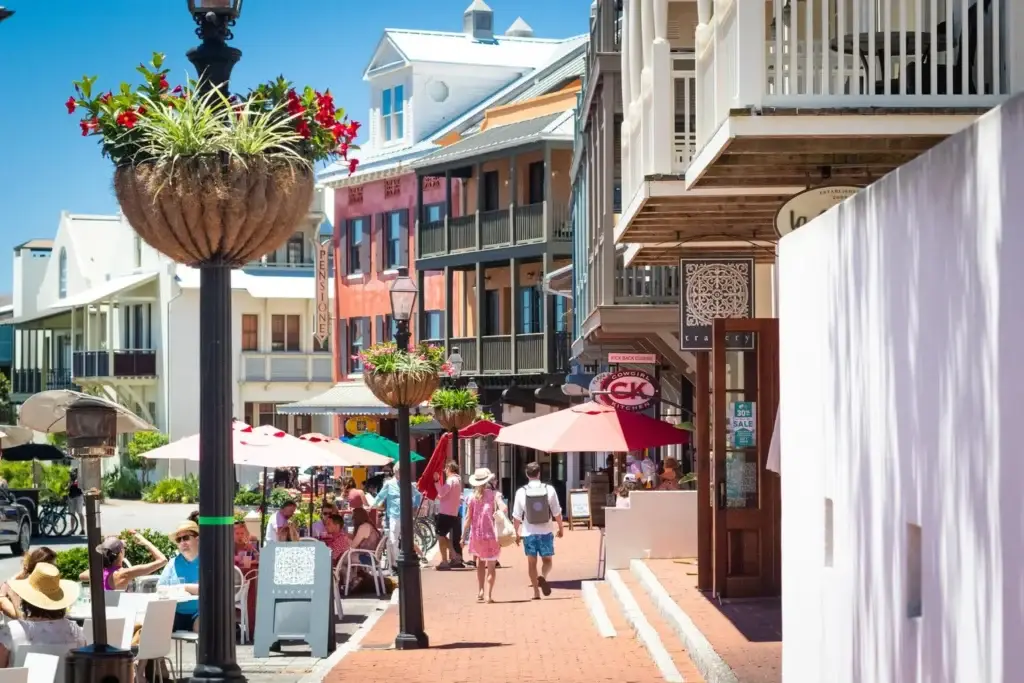
Rosemary Beach is loud during the busy season. The Main Street atmosphere that makes it so popular, with outdoor dining, live music, and kids everywhere, means it is the opposite of a serene retreat.
A few realities to know before you buy:
- Parking enforcement is aggressive. Unauthorized vehicles are towed within hours. Guests need permits and the system is strict.
- The beach gets crowded. With multiple access points and back-row homes holding full beach rights, peak summer weekends can feel dense.
- It is a social scene. If you want your kids to make friends, ride bikes to the ice cream shop, and have dinner at communal outdoor tables, this community was built for that experience.
Buyers drawn to this family-forward energy but comparing broader options should read how Seaside and WaterColor compare as a useful counterpoint, or dig into the living in Seaside guide for a community that delivers similar village energy at a lower entry price. Buyers who want Rosemary’s energy but a more value-oriented footprint should look at Inlet Beach vs. Rosemary Beach directly east.
Alys Beach: Controlled, Serene, and Occasionally Sterile
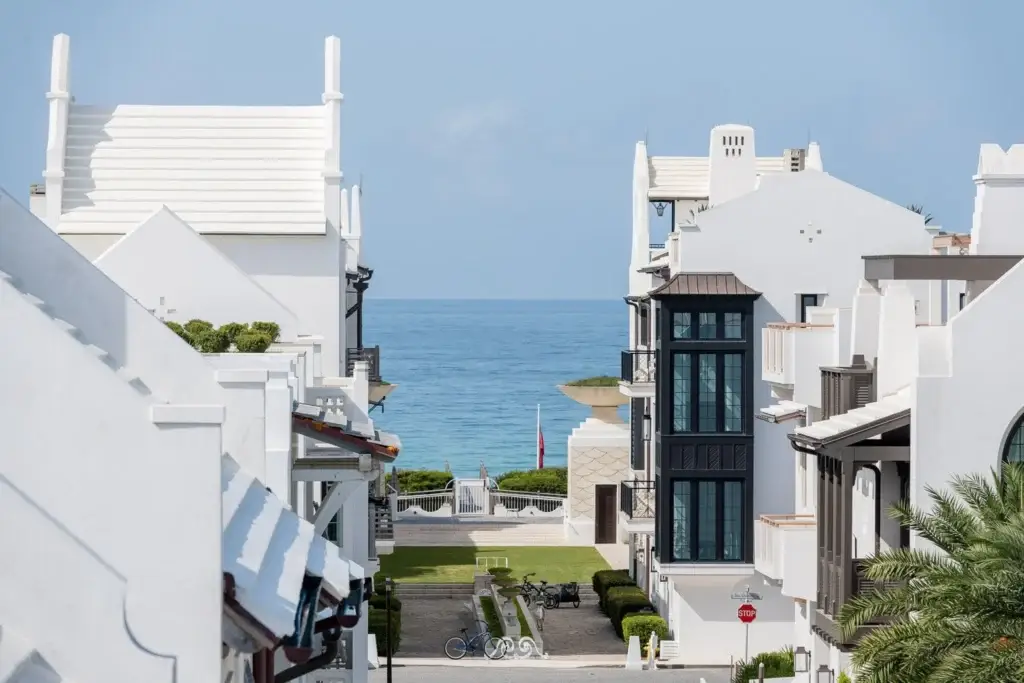
Alys Beach is the anti-Rosemary. The streets are quiet. The courtyards are walled. The aesthetic is camera-ready but can feel almost too controlled.
You will not find kids on bikes or impromptu street gatherings. You will find people reading by private pools and speaking at normal indoor volume. The “Snob Factor” is real. Alys explicitly markets itself as exclusive, and the buyer pool reflects that. If you are looking for a place where everyone knows your name, this is not it. If you are looking for a place where no one will bother you, it is perfect.
The wellness amenities, particularly Zuma, are world-class. Beach access is strictly enforced and significantly less crowded than Rosemary due to lower density. Security is tight and non-residents do not wander through.
For buyers evaluating a similar exclusivity question at a different price point elsewhere on the corridor, the WaterColor vs. Watersound comparison covers how two communities navigate the managed vs. independent lifestyle trade-off in a way that maps directly onto this decision.
Beach Access: How the Two Communities Compare
Both communities provide deeded beach access, but the experience diverges significantly.
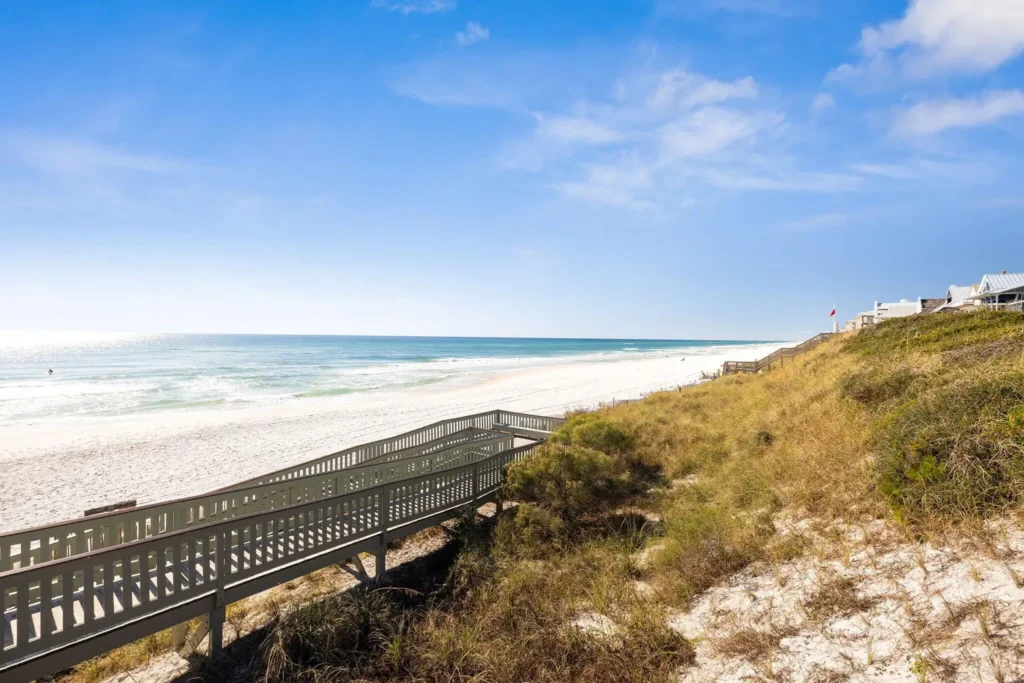
Rosemary Beach has multiple gated walkovers spread throughout the community. They are well-maintained and well-designed. The challenge is density. With several hundred homes sharing the same beach corridor, peak summer weekends can be crowded. The back-row home advantage, where properties without Gulf views still hold full beach rights, adds to the beach population substantially.
Alys Beach beach access is controlled and measurably less crowded. Lower density translates directly to more sand per household. The community enforces access strictly, and non-residents are not wandering through. For buyers whose primary driver is a quiet beach experience, this is a meaningful practical difference.
For a full breakdown of how beach access rights work across 30A, including the ongoing tension between public access and private community control, the 30A beach access guide covers the legal landscape in detail.
Rosemary Beach vs. Alys Beach: Side-by-Side Comparison
| Category | Rosemary Beach | Alys Beach | Edge |
|---|---|---|---|
| Style | Dutch West Indies. Wood siding, deep eaves, warm village feel. | Bermudian/Moorish. Stark white stucco, limestone, walled courtyards. | Draw |
| Construction | Wood-frame. Higher maintenance; susceptible to rot and termites. | Insulated Concrete Form (ICF). Built to Category 5 standards. | Alys Beach |
| HOA Fees | ~$6,000/yr (single-family); ~$20,000+/yr (condos) | ~$14,000/yr (single-family); ~$26,000+/yr (condos) | Rosemary Beach |
| Rental Management | Flexible. Choose your own manager at 15–25% fees. | Mandatory in-house program. Flat 40% fee. No opt-out. | Rosemary Beach |
| Insurance (est. $3M property) | $12,500–$16,000/yr | Lower. ICF construction; FORTIFIED certification saves ~10–15%. | Alys Beach |
| Sound Privacy | Limited. Wood-frame and close spacing transmit noise. | Excellent. Concrete walls deliver true acoustic separation. | Alys Beach |
| Vibe | High-energy and social. Kids on bikes, live music, crowded patios. | Quiet and controlled. Walled courtyards, hushed streets. | Rosemary (families) / Alys (privacy) |
| Beach Crowding | Moderate to high. High density and back-row access rights. | Low. Fewer households per stretch of beach. | Alys Beach |
| Amenities | 4 pools, racquet club, town green. Community-accessible. | Caliza Pool, Zuma Wellness. Ultra-luxury; owners and guests only. | Alys (caliber) / Rosemary (access) |
| Maintenance | High. Repainting, wood rot, and termite mitigation are ongoing. | Low. Integral stucco, no wood rot, no termites in concrete. | Alys Beach |
| Entry Price | $2M–$4M+ (courtyard); $4M–$8M+ (Gulf view) | $3M–$6M+ (courtyard); $8M–$20M+ (Gulf front) | Rosemary Beach |
The Verdict: Who Should Choose Each Community
The Investor (Cash Flow Priority)
Choose Rosemary Beach. The ability to select independent property management and negotiate lower fee structures gives you significantly more control over net returns. Lower entry prices mean better cash-on-cash returns at the same capital outlay. The established brand and predictable demand reduce first-year risk.
The Legacy Buyer (100-Year Asset)
Choose Alys Beach. The fortress-grade concrete construction means this asset will survive the next century of hurricanes, sea-level rise, and insurance cycles. Maintenance costs are structurally lower over the long hold. If you are building generational wealth and plan to hold for 30 years or more, the initial premium pays for itself.
The Family Vacationer (Annual 2-Week Stay)
Choose Rosemary Beach if you want your kids to experience village life: making friends, riding bikes to the ice cream shop, dinner at communal outdoor tables. The density that frustrates privacy-seekers is exactly what creates the vacation memories families return for year after year.
Choose Alys Beach if your ideal vacation is yoga at dawn, spa treatments at Zuma, and avoiding crowds entirely. If your family’s version of luxury is quiet and controlled, Alys delivers it flawlessly.
The Privacy-Focused UHNW Buyer
Choose Alys Beach. The walled courtyards, strict architectural controls, and lower density create an environment where you can genuinely disappear. Rosemary’s village energy is the exact opposite of what you are seeking.
For buyers still deciding where on 30A to anchor their search, the south vs. north of 30A comparison provides useful context on how location within the corridor affects pricing and lifestyle broadly. If you are planning a discovery trip to compare these two communities in person, the guide to getting to 30A covers airports and driving routes from major markets. And for buyers making the full-time move rather than a vacation purchase, the moving to 30A relocation guide and the honest look at living on 30A full-time cover the realities that vacation buyers often underestimate.
Both communities represent the pinnacle of 30A luxury, but they serve fundamentally different buyers. Rosemary Beach is for those who value flexibility, social energy, and cash flow control. Alys Beach is for those who prioritize architectural integrity, privacy, and long-term asset durability. Neither is objectively better. But one is unquestionably right for you depending on whether you value ROI flexibility or fortress construction, crowd energy or genuine quiet.
Choose wisely. At these price points, the cost of getting it wrong is measured in millions.
Frequently Asked Questions
Can I use my own property manager at Rosemary Beach or Alys Beach?
At Rosemary Beach, owners generally have the freedom to hire independent property managers, which allows you to negotiate fee rates typically in the 15–25% range and retain a larger share of rental revenue. Alys Beach operates differently: any owner who wishes to rent their property as a short-term rental is required to use the Alys Beach in-house rental management program at a mandatory flat 40% fee. There is no opt-out for independent management. This management structure difference is one of the most financially significant factors separating the two communities for investors.
Which has lower HOA fees: Rosemary Beach or Alys Beach?
Rosemary Beach HOA fees run approximately $6,000 per year for single-family homes and $20,000 or more annually for condo properties, covering community pools, beach walkover access, and town green maintenance, with capital assessments adding additional cost. Alys Beach fees are substantially higher: approximately $14,000 per year for single-family homes and $26,000 or more annually for condos, funding the Caliza Pool, Zuma Wellness Center, and community infrastructure. The gap is real and should be factored into any year-one ownership budget.
Is Alys Beach worth the premium over Rosemary Beach?
For the right buyer, yes. Alys Beach’s ICF concrete construction, lower maintenance demands, superior insurance profile, and acoustic privacy create a fundamentally different ownership experience than anything wood-frame can deliver. But if your priority is rental income, management flexibility, or a social family community, Rosemary Beach may generate better returns on less capital. The answer depends entirely on your use case: legacy holds and lifestyle luxury favor Alys, while cash flow optimization and family energy favor Rosemary.
Running the numbers on Rosemary Beach or Alys Beach?
These are two very different investments and the wrong choice at this price point is a multi-million-dollar mistake. I work both markets closely and can walk you through the real ownership math before you commit to either one.
Call or Text Me: 850-585-0642
Email: andy@livingon30aflorida.com

Pingback: Getting to 30A: Closest Airports (ECP vs VPS) & Driving Routes
Pingback: South of 30A vs. North of 30A: Real Costs, Value & Data (2026)
Pingback: Living in Seaside FL: True Costs, HOA Rules & Reality (2026)
Pingback: 30A Beach Access: Public vs. Private Rules (2026 Guide)
Pingback: Living in Alys Beach FL: The Ultimate Luxury Guide (2026 Costs & Rules)
Pingback: The Real 30A Florida Guide: Towns, Truths & East vs. West