

WaterColor, Florida is a master-planned luxury community on Scenic Highway 30A featuring eight distinct residential districts, a private Beach Club, Camp WaterColor family amenities, and strict HOA governance. Annual lifestyle costs beyond the mortgage—including HOA fees, guest fees, beach setups, and mandatory golf cart rentals—typically run $8,000–$12,000+.
This guide provides the hard data on costs, restrictions, and operational realities—expenses that vary significantly depending on where you buy along 30A—from the exclusive golf cart monopoly to the occupancy-based wristband system—that most real estate brochures leave out.
The Real Cost of Living in WaterColor
Below is a breakdown of the estimated annual carrying costs for 2025, based on current Walton County property data and local HOA records. Florida property tax rates apply uniformly, but actual amounts vary by assessed value.
| Expense Item | Estimated Cost | Crucial Details |
|---|---|---|
| HOA Fees | $1,200/qtr – $6,000+/yr | Varies heavily by district and lot size |
| Guest Fees | $9/person/night | Charged on max certified occupancy for unaccompanied guests/renters |
| Property Tax | ~0.8–1.0% | Based on Walton County effective rates (ad valorem) |
| Beach Setup | $45–$105/day | 2 chairs + umbrella. Peak pricing applies June–August |
| Insurance | $3,000–$5,000+ | Wind/Flood is mandatory for mortgages; premiums are rising |
| Cart Rental | $600+/week | Must use the Electric Cart Company (exclusive vendor) |
The “Nickel-and-Dime” Factor
The purchase price is just the entry fee—and how that entry fee compares across 30A communities matters. The “lifestyle costs” accumulate quickly. A family of four spending a week at the beach will pay $300–$600+ just for chair setups. If you rent your home or let friends use it unaccompanied, the $9/person/night fee applies to the total capacity of the house, not just the number of guests staying. If your home sleeps 10, you pay for 10.
Insurance deserves special attention. Coastal properties in this zone carry wind and flood premiums that shock first-time buyers accustomed to inland rates—a reality shared across every 30A community from WaterColor to Alys Beach. The $3,000–$5,000 range assumes standard coverage; expanded policies for high-value homes push annual premiums considerably higher.
The “Boring” Rules You Must Know
The Wristband Math & Occupancy Limits
WaterColor’s wristband system is the community’s primary access control. Every resident and guest aged 5 and older must wear a wristband to access the Beach Club, Camp WaterColor, and community pools.
The Rule: Bands are tied to your home’s certified rental occupancy, which is determined during HOA approval based on bedroom count and livable square footage.
The Friction: You cannot simply request extra bands for a dinner party at the club. If your home is certified for 8 people, you get 8 bands. Want to host a larger gathering? You’ll need to petition the HOA board, and approval isn’t guaranteed.
The Cost: Lost bands cost $50+ to replace, and the HOA offices are closed on weekends, meaning a lost band on Friday means no pool access until Monday.
For rental properties, the $9/person/night guest fee is calculated on maximum certified occupancy, not actual occupancy—so even if only six people show up to your eight-person rental, you’re charged for eight. Property managers factor this into rental pricing, but owners need to understand it affects net rental income calculations.
The Strict Golf Cart (LSV) Policy
WaterColor enforces a rigid “One Cart Per Address” rule that’s strictly enforced.
The Monopoly: The Electric Cart Company (ECC) is the only authorized rental vendor within the community. Outside rentals—even if you own one—are prohibited and will be towed without warning.
The Shortage: During peak season (Memorial Day to Labor Day), carts sell out months in advance. If you don’t book your cart when you book your house, you will be walking. The ECC prioritizes property owners, but availability still vanishes quickly.
The Condo Ban: Many Town Center condos are prohibited from renting carts entirely due to a lack of charging infrastructure. These residents rely entirely on bikes or walking.
Enforcement is serious. The HOA contracts security to patrol for unauthorized carts, and towing happens swiftly with no grace period or warnings.
Amenities Guide: Beach Club vs. Camp WaterColor
WaterColor Beach Club (The “Resort” Hub)
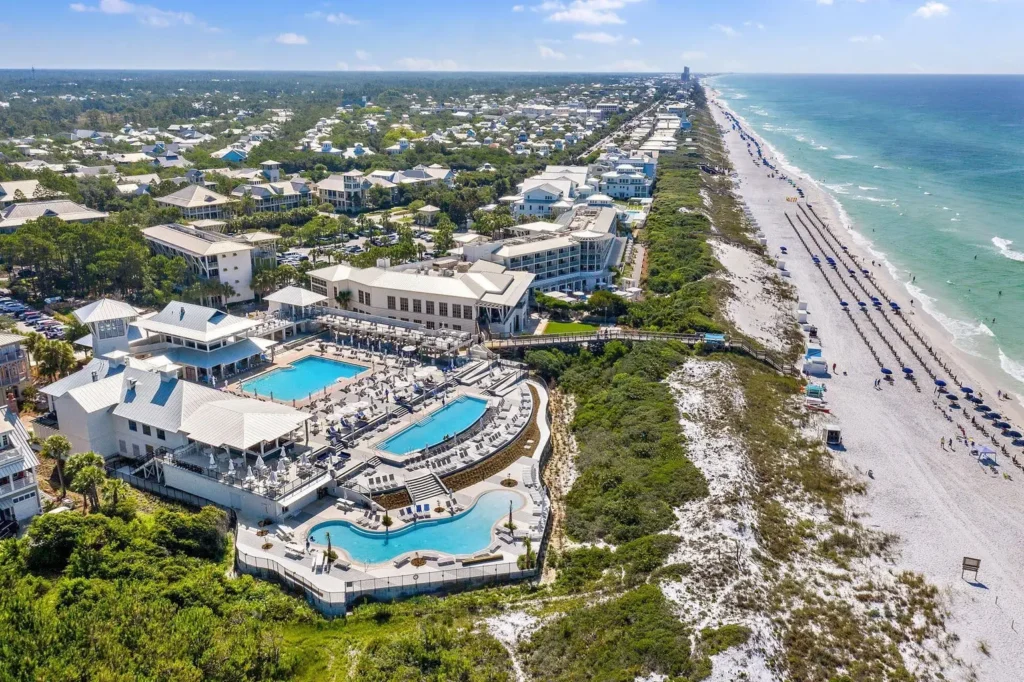
This is the flagship amenity with Gulf views, a full-service bar, and tiered pools. It’s also the primary choke point for summer crowds.
The Reality: In July, if you do not arrive by 10:00 AM, you will likely struggle to find a chair. The “towel game” (reserving chairs) is strictly policed—staff will remove towels left unattended for 30 minutes. Show up at 1 PM and you’re relegated to back rows with obstructed views or overflow areas lacking shade.
The Beach Club restaurant provides convenience but limited menu options. Service slows considerably during peak meal times when rental turnover peaks (Saturday check-ins create weekend surges).
Camp WaterColor (The “Family” Hub)
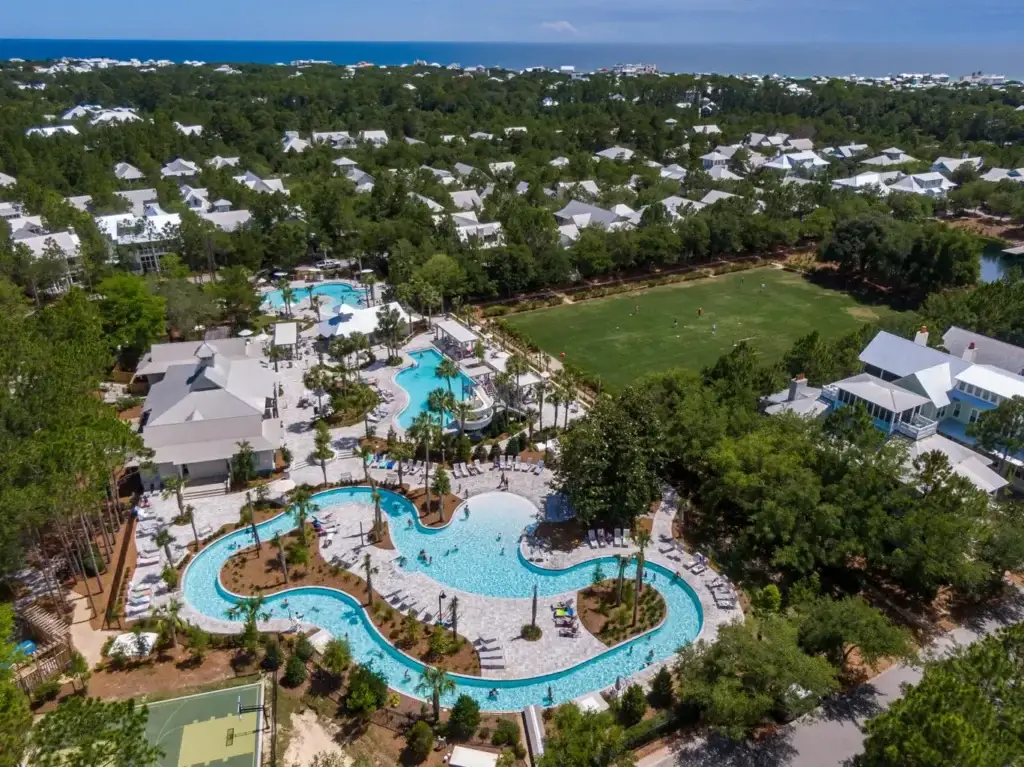
Located inland, this facility features a lazy river, corkscrew slide, splash zones, and basketball courts. The vibe skews younger and louder, which is intentional design for families.
The Reality: It creates a “split” vacation for families. Parents often want the Beach Club views, while kids want the Camp slides. Moving between the two requires a logistical commitment (loading the cart or bike trailer), as they are nearly a mile apart. Families without carts face the daily calculation of which amenity to prioritize, as the bike ride between them with full beach loads isn’t practical for most.
Camp programming (kids activities, crafts, games) requires separate registration and fills quickly for popular time slots.
Understanding the Districts: A “Vibe” Check
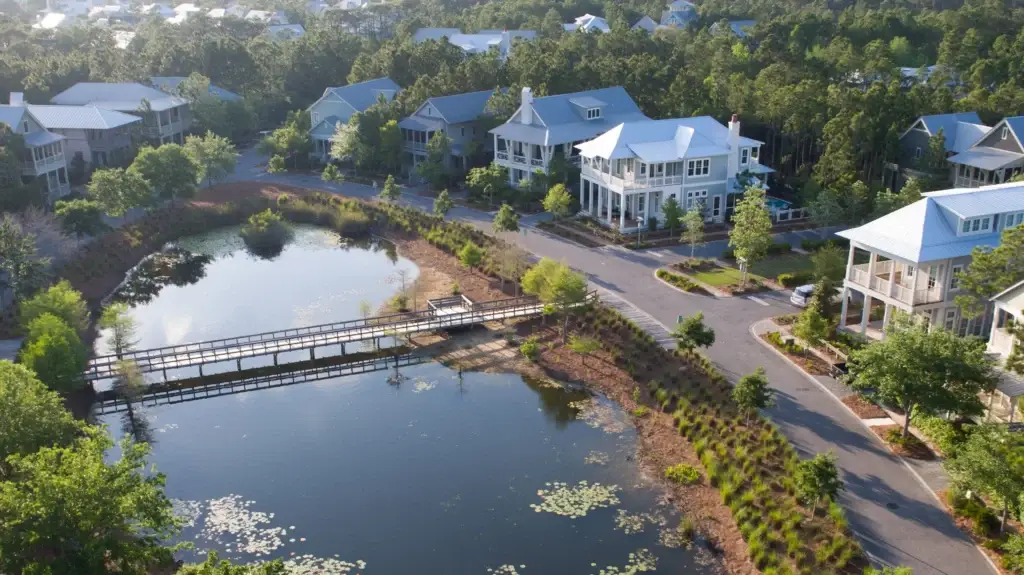
WaterColor is divided into 8 distinct districts across 5 development phases, each with different lifestyle trade-offs and rental regulations—a structure that differs significantly from neighboring Watersound.
| District | Phase | The Vibe | Best For… | The Trade-off |
|---|---|---|---|---|
| Gulf District | Phase 1 | Ultra-exclusive, oceanfront | Investors and view chasers | Zero privacy; constant noise |
| Beach District | Phase 1 | Dense, cottage-style | Short-term rental investors | Parking is a nightmare |
| Cottage District | Phase 1 | Classic WaterColor aesthetic | High-occupancy rentals | Tight lots; heavy foot traffic |
| Camp District | Phase 2 | Wooded, family-focused | Families with young kids | Long haul to beach; requires cart |
| Forest District | Phase 2 | Secluded, borders forest | Second-home owners | Inconvenient amenity access |
| Lake District | Phase 3 | Private, residential | Privacy seekers | 15+ min bike ride to ocean |
| Crossing District | Phase 4 | Near Publix, practical | Value buyers and locals | Feels “suburban,” not coastal |
| Park District | Phase 5 | Neighborhood-focused | Full-time residents | No rental income allowed |
🏡 The Phase V Advantage: WaterColor’s Only “Real Neighborhood”
Park District (Phase 5) deserves special attention as it represents a fundamentally different ownership model within WaterColor:
Final Phase Development: Phase V was the last land developed in WaterColor, meaning homes here are newer construction (predominantly built 2010s-2020s) with modern floor plans and updated building codes.
The No-Rental Rule: This is the only district in WaterColor that prohibits short-term vacation rentals. Properties in Phase V are restricted to owner-occupancy or long-term leases (typically 6+ months minimum).
The Benefit: Because of this restriction, Park District is the only place with authentic “neighborhood” character. You won’t experience:
- Saturday turnover chaos with cleaning crews and rental vans
- Bachelor parties or large groups treating homes like hotel suites
- Weekly trash overflows from rental guests
- Revolving-door neighbors who don’t know community norms
The Trade-off: The rental prohibition significantly impacts resale liquidity and eliminates rental income potential. Your buyer pool shrinks to full-time residents and second-home owners who don’t need rental offset. Properties here typically sell for 10-15% less per square foot than comparable homes in rental-allowed districts, despite being newer construction.
Who It’s For: Park District works for buyers who value stability over investment returns—retirees, remote workers, families relocating to 30A and seeking year-round community for their kids. If you’re buying WaterColor as a primary residence and the “resortification” concerns you, Phase V is your only option.
The essential calculation: Proximity to Beach Club correlates inversely with residential livability across most districts. Gulf, Beach, and Cottage Districts generate maximum rental revenue but experience maximum disruption. Lake and Forest Districts offer quiet but sacrifice beach access. Park District splits the difference—reasonable amenity access with genuine neighborhood stability, but zero rental income potential.
The Cons: Crowds, Traffic, and “Resortification”
⚠️ Reality Check:
The Crowd Funnel: Unlike Seaside, which has multiple street pavilions, WaterColor funnels thousands of guests into a single beach access point.
Saturday Swap: Saturday traffic on 30A is gridlock. The constant turnover of rental guests creates a “move-in day” atmosphere every weekend.
Density: The beach setup rows can run 4–5 deep. If you are in the back row, you will not see the water.
The Crowd Funnel
WaterColor’s density problem stems from design. Unlike Seaside’s multiple beach access points distributing crowds, WaterColor concentrates hundreds of properties through a single primary beach access at the Beach Club. Summer weekends on 30A create a resort-level crush that overwhelms the intended ‘private community’ experience.
The walkway to the beach becomes congested where you’ll wait for groups to move, navigate around stopped clusters taking photos, and experience the opposite of secluded coastal living. Beach chair setups can run 4–5 rows deep; back row positions mean obstructed water views and reduced breeze.
The Rental Tension
The community operates in permanent tension between full-time owners seeking neighborhood stability and the short-term rental economy that drives property values. Saturday turnover days bring parade of cleaning crews, maintenance trucks, and rental vans creating traffic and noise. Service vehicle restrictions exist but enforcement remains inconsistent.
Full-time residents report frustration with revolving-door neighbors who don’t understand community norms—one reason some buyers opt for less managed communities like Grayton Beach instead. Parking violations, noise after quiet hours, and improper trash disposal are a few additional factors that offer challenges for full-time residents. The HOA attempts mediation, but the economic incentive toward rentals means these issues persist as a structural feature rather than a solvable problem.
30A Traffic Reality
The “golf cart lifestyle” isn’t an aesthetic choice—it’s operational necessity. Driving on 30A during peak season means 20-30 minute delays for what should be 5-minute trips. The two-lane road wasn’t designed for current density, and backups extend from Seaside to Rosemary Beach during summer afternoons.
This transforms golf carts from luxury to requirement, which circles back to the ECC monopoly problem. When carts become mandatory infrastructure but availability is artificially constrained by exclusive vendor agreements, residents face genuine mobility limitations.
Investment Potential: Rental Rules & ROI
WaterColor is one of the strongest short-term rental markets on 30A, but the ROI math is more complicated than most listing agents will present.
Short-term rentals are permitted in all districts except Park District (Phase 5). Peak-season nightly rates for a 3-bedroom home typically range from $500 to $1,000+ per night, with Gulf District and Beach District properties commanding the highest premiums. Off-season rates drop 40 to 60%, and shoulder months like September, October, and March perform inconsistently.
Realistic annual occupancy for a well-marketed WaterColor rental sits around 55 to 65%. The properties that outperform tend to be in Gulf, Beach, or Cottage Districts with high certified occupancy counts and strong management company placement.
Here’s where the math gets complicated. WaterColor’s carrying costs are higher than most 30A communities. Stack the HOA fees, the $9/person/night guest fees on maximum certified occupancy, property management fees (typically 20 to 25% of gross), beach setup costs passed through to guests, insurance, property taxes, and accelerated coastal maintenance. Many properties net 3 to 5% annual cash-on-cash return at best. Some break even.
The real investment thesis for WaterColor is long-term appreciation plus lifestyle access, not rental cash flow. Properties in WaterColor have historically appreciated well due to the community’s brand strength and amenity infrastructure, but buying here purely as a rental investment without the lifestyle component rarely pencils out against less expensive 30A alternatives.
Before purchasing, request the specific rental history for the property, not community averages. Run your numbers using the $9/person/night guest fee on full certified occupancy, not actual guest counts.
Living in WaterColor vs. Seaside vs. Rosemary Beach
WaterColor vs. Seaside: Our full Seaside vs WaterColor comparison covers this in depth, but the short version is that WaterColor is larger and feels more like a private resort with gated amenities and private Beach Club. WaterColor offers superior pool amenities (Camp + Beach Club) but heavier density at the beach. Seaside has multiple beach access points distributing crowds better, with better retail walkability but heavy tourist foot traffic right past front porches. Seaside feels more like a walkable small town; WaterColor feels like a managed resort.
WaterColor vs. Rosemary Beach: Rosemary Beach feels like a European village—cobblestone streets, masonry construction, courtyard architecture, tight lots, and high-end retail integration. WaterColor maintains Southern estate character with pine straw paths, wood siding, wide porches, and more spacious lots. Rosemary has better crowd distribution at the beach with multiple access points. Rosemary commands higher price per square foot but smaller average home sizes—and competes with Alys Beach for the luxury buyer’s attention. Rosemary feels urban-coastal; WaterColor feels estate-coastal.
Both Seaside and Rosemary operate with similar HOA/amenity fee structures, meaning WaterColor’s costs aren’t outliers for the 30A market. The differentiator becomes amenity quality versus crowd management—WaterColor invested heavily in Beach Club and Camp infrastructure but underbuilt beach access relative to density.
Final Verdict
WaterColor is an exceptional community if you view it as a managed resort. If you expect the autonomy of a traditional neighborhood, the rules (wristbands, cart limits, occupancy checks) will chafe.
For buyers who can budget $10,000+ annually in non-mortgage lifestyle fees and accept managed community trade-offs, WaterColor delivers on its luxury positioning with resort-grade amenities. The costs extend beyond mortgage—between HOA fees, guest charges, daily beach setups, and mandatory cart rentals, plan for $8,000–$12,000 annually in lifestyle expenses before discretionary spending.
The honest assessment: WaterColor works best as a vacation property where rental income offsets fees and restrictions, or as a second home for owners who embrace the resort model. As a full-time 30A residence, the crowd density, rental churn, and rule enforcement create lifestyle compromises that contradict the premium pricing. For those expecting the spontaneous simplicity suggested by marketing materials, the operational reality will disappoint.
Frequently Asked Questions About Living in WaterColor, FL
Q1: How much does it cost to live in WaterColor, FL beyond the mortgage?
Expect $8,000–$12,000+ annually in lifestyle costs including HOA fees, guest fees calculated at $9 per person per night based on maximum certified occupancy, beach chair setups at $45–$105 per day, mandatory golf cart rentals, and coastal wind and flood insurance premiums that can exceed $5,000 per year.
Q2: Can you rent your home short-term in WaterColor, FL?
Short-term rentals are allowed in all WaterColor districts except Park District (Phase 5), which restricts properties to owner-occupancy or long-term leases of six months or more. Rental properties are subject to guest fees based on maximum certified occupancy and must comply with the community’s wristband access system.
Q3: What is the best district to live in WaterColor, FL full-time?
Park District (Phase 5) is the only WaterColor district that prohibits short-term rentals, making it the best option for full-time residents seeking neighborhood stability. It offers newer construction and reasonable amenity access without the weekly rental turnover experienced in other districts.
Considering a Move to Watercolor?
WaterColor’s district differences, guest fee structure, and wristband policies create a financial picture that goes well beyond the listing price. Before you commit, talk to someone who knows which districts actually deliver on the lifestyle you’re looking for. Book a free discovery call and get the real numbers.


Pingback: Getting to 30A: Closest Airports (ECP vs VPS) & Driving Routes
Pingback: 30A Beach Access: Public vs. Private Rules (2026 Guide)
Pingback: WaterColor vs Watersound Beach: Cost, Rules & Honest Comparison (2026)
Pingback: The Real 30A Florida Guide: Towns, Truths & East vs. West