

High-income earners face a problem that sounds almost embarrassing to complain about: they make a lot of money, and the federal government takes a significant portion of it. What most physicians, executives, and business owners don’t realize is that a short-term rental property on 30A, structured correctly, is one of the most effective legal tools in the U.S. tax code for addressing that problem. This article explains how it works, what it actually takes to qualify, and what the numbers look like in the real world.
Note: I am a real estate advisor, not a CPA or tax attorney. Everything here is for educational purposes only. Before making any financial decision based on this strategy, talk to a qualified CPA first.
What Is the 30A Real Estate Tax Strategy?
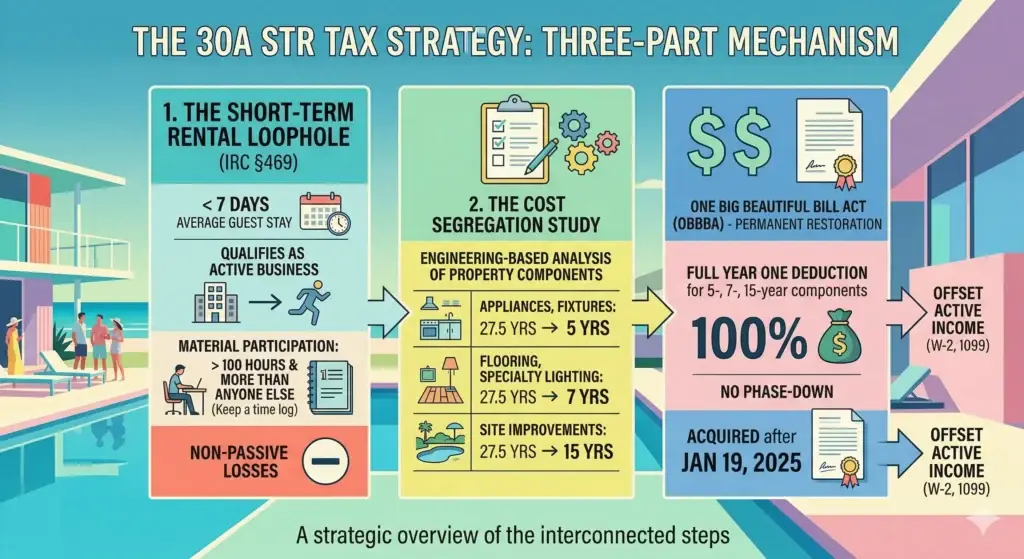
The 30A real estate tax strategy combines three IRS-sanctioned tools: the short-term rental exception to passive activity rules, a cost segregation study, and 100% bonus depreciation under the One Big Beautiful Bill Act. When structured correctly in Year One, the result is a large, front-loaded deduction that directly offsets W-2 or 1099 income with no income-based cap.
Most people think of real estate as a passive investment. Under IRS rules, that’s usually exactly how it’s classified. Passive losses can only offset passive income, which means the depreciation sitting inside your rental property is largely useless for offsetting your salary or business income. The short-term rental exception changes that classification entirely. When you structure the property correctly and meet the IRS requirements in Year One, the losses become non-passive and go directly against active income. Layer in a cost segregation study and 100% bonus depreciation, and the Year One deduction can be substantial.
This is not a gray area. The strategy is built on established IRS code sections that have been in place for decades. For a full breakdown of passive activity rules, see IRS Publication 925.
Who This Strategy Is Built For
This is not a strategy for everyone. It is specifically well-suited for high-income earners who are paying significant federal income tax each year and want a legal way to reduce that burden through a real asset they actually want to own.
The buyers who benefit most tend to fall into a few profiles. Physicians in the 37% bracket who earn W-2 income and don’t have flexible income structures. Business owners and executives who take income across both W-2 and 1099 structures. Ultra-high-net-worth individuals using this as one component of a broader tax plan that may also include 1031 exchanges and family entity structures.
What these buyers share: they pay a lot in taxes, they want to own coastal real estate anyway, and they are sophisticated enough to execute a strategy that requires CPA coordination and documentation discipline.
If you’re considering relocating to 30A or buying as a second home, our complete 30A guide is a good starting point for understanding the market before thinking about specific investment structures.
The Three-Part Mechanism Explained
The strategy has three moving parts. Each one matters. None of them works in isolation.
Part 1: The Short-Term Rental Loophole
Under IRC Section 469, rental activity is generally treated as passive. There is a specific exception. If the average rental period for your guests is seven days or fewer, the property falls outside the standard rental activity definition and is treated more like an active business.
That reclassification is critical. Once the property is no longer classified as a rental activity, and once you also meet the IRS material participation standard, the losses it generates are non-passive. They can offset your W-2 wages, your 1099 business income, or other active income directly.
Material participation is the qualifying hurdle. The IRS has seven tests. You need to satisfy just one. The two most commonly used by short-term rental owners are:
- Test 1: 500 or more hours on the activity during the tax year
- Test 2 (most common): 100 or more hours AND more hours than anyone else involved in the activity, including a property manager
That second test is where buyers need to be strategic. If you hire a full-service property management company to handle all day-to-day operations, the manager’s hours will almost certainly exceed yours. That disqualifies you from Test 2. Owners who want to use this strategy need to be genuinely active in managing the property, handling bookings, guest communication, maintenance coordination, financial review, and similar activities. Keep a contemporaneous time log. Document everything.
Qualifying activities include coordinating bookings, managing maintenance requests, communicating with guests, reviewing financials, and researching property improvements. An attorney or CPA can help you determine which activities count and how to document them correctly.
One important clarification: the material participation test applies in Year One to unlock the non-passive classification and capture the front-loaded deduction. The deduction itself, once taken, is yours. More on that in the Year One section below.
Part 2: The Cost Segregation Study
Normal depreciation for residential rental property runs over 27.5 years. That produces a modest annual deduction. A cost segregation study changes the math dramatically.
A cost segregation study is an engineering-based analysis that breaks a property down into its individual components and reclassifies each one into the appropriate depreciation schedule. Many components inside a well-appointed 30A beach home depreciate much faster than the building structure itself.
| Component Examples | Standard Schedule | After Cost Segregation |
|---|---|---|
| Appliances, fixtures, cabinetry | 27.5 years | 5 years |
| Flooring, specialty lighting, decking | 27.5 years | 7 years |
| Parking, landscaping, site improvements | 27.5 years | 15 years |
| Building structure | 27.5 years | 27.5 years (unchanged) |
A well-furnished 30A property typically sees 25 to 35 percent of its depreciable basis reclassified into shorter schedules. Pools, outdoor kitchens, premium finishes, and landscaping all qualify. The coastal build quality and luxury finishes common on 30A actually accelerate this process compared to a typical residential property.
The study itself costs between $8,000 and $15,000 at these price points, performed by a credentialed engineering firm. It is typically commissioned at or shortly after closing. The one-time cost pays back many times over in Year One.
Part 3: Bonus Depreciation Under the One Big Beautiful Bill Act
Once the cost segregation study identifies the reclassified components, those components become eligible for bonus depreciation. Bonus depreciation allows you to take the full deduction in Year One rather than spreading it over the component’s depreciation schedule.
The One Big Beautiful Bill Act, signed into law on July 4, 2025, permanently restored 100% bonus depreciation for qualifying property acquired and placed in service after January 19, 2025. For more details on the legislation, see the IRS OBBBA summary page. There is no longer a phase-down schedule to race against. However, your acquisition date still determines eligibility. If your purchase contract was signed before January 20, 2025, the rules are more complicated. Your CPA must confirm whether your specific purchase qualifies.
This is where the strategy becomes financially significant. The combination of cost segregation reclassification plus 100% bonus depreciation means the front-loaded Year One deduction can represent a substantial percentage of the property’s purchase price.
Three Buyer Profiles: What Year One Actually Looks Like
The following case studies are illustrative estimates based on consistent assumptions: property acquired after January 19, 2025; average rental period of seven days or fewer; owner meets material participation; cost segregation study completed at closing reclassifying 30% of depreciable basis; 100% bonus depreciation applied per the OBBBA; land estimated at 15% of purchase price. These figures are simplified and rounded. Your actual deduction will depend on your specific tax return and cost segregation report. State income tax treatment may vary. This is not a tax projection. Take these numbers to your CPA.
Profile 1: The Physician
| Purchase Price | $1,500,000 |
| Annual W-2 Income | $650,000 |
| Depreciable Basis | $1,275,000 |
| Cost Seg Reclassified | $382,500 |
| Est. Year-One Deduction | ~$414,950 |
| Est. Tax Offset (37% bracket) | ~$153,500 |
A single-income physician is purchasing her first investment property on 30A. After completing a cost segregation study and meeting material participation requirements, her estimated Year One deduction of ~$414,950 offsets roughly $153,500 in federal tax. That is more than 10% of her purchase price returned in Year One.
Profile 2: The Business Owners
| Purchase Price | $3,500,000 |
| Combined W-2 + 1099 Income | $1,200,000 |
| Depreciable Basis | $2,975,000 |
| Cost Seg Reclassified | $892,500 |
| Est. Year-One Deduction | ~$968,200 |
| Est. Tax Offset (37% bracket) | ~$358,200 |
A founder and executive couple with income across both W-2 and 1099 structures. Their estimated ~$968,200 Year One deduction generates approximately $358,200 in federal tax offset. For buyers in this position, the tax savings can effectively subsidize a significant portion of the first year’s carrying costs. Their CPA should also review how the qualified business income deduction interacts with these losses.
Profile 3: The UHNW Buyer
| Purchase Price | $5,000,000 |
| Annual Income | $3,000,000+ |
| Depreciable Basis | $4,250,000 |
| Cost Seg Reclassified | $1,275,000 |
| Est. Year-One Deduction | ~$1,383,200 |
| Est. Tax Offset (37% bracket) | ~$511,800 |
At this level, the strategy functions as a meaningful portfolio tax tool alongside 1031 exchanges and family entity structures. The estimated ~$1.38 million Year One deduction produces approximately $511,800 in federal tax offset. Attorney and CPA involvement at acquisition is standard at this price point, and that coordination makes the execution cleaner.
What the numbers tell you across all three profiles: the dollar value of the deduction scales with purchase price, but the strategy is productive at all three levels. Higher income amplifies the benefit because the same deduction is worth more in a higher bracket. And in each case, the heavy lifting is front-loaded into Year One.
For specific communities at these price points, our deep-dive guides on living in Alys Beach, living in Rosemary Beach, and the Rosemary Beach vs. Alys Beach comparison cover what ownership actually costs and looks like in the luxury tier.
Year One Is Where the Heavy Lifting Happens
Here is the single most important thing to understand about this strategy: the major tax benefit is a one-time, front-loaded event. You do not need to manage your property as an active short-term rental indefinitely to capture it.
In Year One, you purchase the property, operate it as a short-term rental with average stays of seven days or fewer, meet the material participation test, and commission the cost segregation study. That combination activates the non-passive treatment and unlocks the bonus depreciation. The deduction is taken on your Year One tax return.
Starting in Year Two, you own the property. You can continue running it as a short-term rental, shift to occasional rentals, or use it entirely as a second home. The Year One deduction has already happened. It does not depend on what you do with the property next.
This is genuinely different from strategies that require ongoing operational compliance to maintain the benefit. The value here is primarily driven by the front-loaded bonus depreciation, which is a permanent deduction from the moment it’s claimed.
There is one thing every buyer needs to understand clearly before going in: this strategy defers taxes, it does not eliminate them. When you take accelerated depreciation, you are pulling future deductions into Year One. When you eventually sell, you will owe depreciation recapture tax on the amount taken, at a maximum federal rate of 25%, on top of any capital gains tax on appreciation. The tax bill does not disappear. It gets paid at closing.
The exception is a 1031 exchange. A 1031 exchange rolls your basis, including the deferred depreciation, into a replacement property. The recapture defers again. Some investors do this repeatedly, or hold properties until death when heirs may receive a stepped-up basis under current law. But future legislation could change that.
The right framing: you are optimizing the timing of your tax liability, not eliminating it. For high-income earners paying 37% this year, using a deduction that reduces this year’s bill and deferring the recapture to a future sale is often a financially sound trade, especially when paired with a 1031 exchange exit strategy.
Florida’s Tax Environment Makes This Stronger
Florida has no state income tax. That detail matters more than most buyers realize when thinking about a strategy designed to reduce taxable income.
In most states, reducing federal taxable income has a corresponding state income tax benefit. In Florida, you are already operating in a zero state income tax environment. What the STR tax strategy does is reduce your federal burden, which for buyers in the 37% bracket is where the real money is. If you are relocating to 30A from a high-tax state, the combination of Florida’s tax environment and the Year One strategy can produce a meaningful shift in your overall tax picture.
Our guide to living on 30A full-time covers the broader financial realities of full-time Florida residency, including homestead exemption eligibility and what year-round ownership actually costs. If you are considering a primary residence rather than a pure investment, those details matter.
For buyers relocating from out of state, our moving to 30A relocation guide covers the practical logistics of establishing Florida residency.
Which 30A Properties Work Best for This Strategy
Not every property on 30A is equally suited for this strategy. Several factors determine whether a property will perform well.
Price point and depreciable basis matter. The strategy is front-loaded on depreciation, which means a higher depreciable basis produces a larger deduction. Properties with a significant portion of value in improvements, finishes, pools, outdoor living, and built-ins give a cost segregation study more to work with. Land does not depreciate, so properties where land represents a smaller percentage of total value are generally more favorable. Some townhome units carry zero land value and as a result are great options for those considering the strategy at a lower price point.
Luxury finishes accelerate reclassification. The premium build quality common on 30A is genuinely advantageous here. High-end appliances, outdoor kitchens, specialty flooring, custom cabinetry, pool and deck systems, and landscaping all qualify for accelerated schedules under cost segregation. A well-furnished 30A beach home typically sees 25 to 35 percent of its depreciable basis reclassified, which is higher than a comparable property in a less appointment-heavy market.
STR rental history and occupancy matter for the income side. If you plan to continue renting the property beyond Year One, the location’s short-term rental demand supports the income side of the equation. The most active short-term rental markets on 30A are the communities with the highest foot traffic, established rental platforms, and strong summer demand. Our guides on living in Seaside, living in WaterColor, and living in Grayton Beach cover what rental activity actually looks like in each community.
Property structure. Single-family homes and Gulf-front or Gulf-view properties with pools perform best for short-term rentals on 30A. Condos can work, but HOA rules, financing constraints, and shared amenity management add complexity. Understanding the differences between communities on 30A is essential before narrowing down a purchase.
The Honest Risks and Limitations You Need to Understand
This strategy is legal, established, and specifically designed into the tax code. It is also not simple to execute, and the cost of getting it wrong is significant. Here is what the optimistic version of this conversation usually leaves out.
IRS audit risk is real and increasing. The STR loophole is on the IRS’s radar. Audit rates for returns claiming non-passive treatment from short-term rentals have increased. That does not mean you should avoid the strategy. It means you need to execute it correctly and document everything from the moment you close.
Material participation documentation is essential. If you are audited and cannot substantiate your participation hours with contemporaneous records, your losses can be reclassified as passive. That means back taxes, interest, and potential penalties. A calendar, time logs, and records of your qualifying activities are not optional. They are the strategy.
Full-service property management is incompatible with Test 2. If you hand the property entirely to a property management company, you will almost certainly fail the material participation test. Buyers who want to use a full-service manager need to be honest with their CPA about whether they can realistically meet Test 1 (500 hours) instead. Many cannot.
The strategy works best with qualified professional guidance. This is not a DIY project. A CPA who works regularly with short-term rental investors understands the documentation requirements, the material participation tests, and the depreciation recapture implications in a way that a general-practice accountant often does not.
Depreciation recapture will come due. As covered earlier, this strategy defers taxes. It does not eliminate them. Every buyer should model the sale scenario with their CPA before purchasing to understand exactly what recapture will look like at exit.
Investment Potential: Rental Income and ROI on 30A
Beyond the Year One tax benefit, 30A is one of the most productive short-term rental markets in the Southeast. The combination of a short high-season window, high average nightly rates, and strong repeat visitor demand produces gross rental figures that support the carrying costs of ownership at the luxury price points this strategy targets.
To give you a realistic baseline, here is what well-managed short-term rentals in established 30A communities have been generating at these price points:
| Purchase Price | Est. Annual Gross Rental Revenue |
|---|---|
| ~$1,500,000 | $90,000 to $150,000 |
| ~$3,500,000 | $160,000 to $285,000 |
| ~$5,000,000 | $300,000 to $425,000 |
These ranges reflect properties actively marketed and managed. Actual performance depends on location, finishes, pool access, walkability, and how the property is listed and priced.
Property management on 30A typically runs between 10% and 40% of gross revenue depending on the level of service. The market average is 20%, which most full-service local companies charge. Self-management can improve net returns but affects material participation strategy in the ways described above, so that tradeoff needs to be part of the conversation with your CPA.
For community-specific context on what rental activity looks like in different parts of 30A, the WaterColor vs. Watersound comparison, the Inlet Beach vs. Rosemary Beach guide, and the Seagrove vs. Grayton Beach comparison all include investment potential sections that break down what ownership looks like in each market. The Seaside vs. WaterColor comparison covers the most active rental markets in the east end corridor.
Your Next Three Steps
If this strategy sounds like it could fit your financial picture, here is the sequence that works.
Step 1
Talk to your CPA before you look at a single property. The strategy only works if your income profile, tax situation, and ability to meet material participation requirements align. Your CPA needs to confirm that before you start shopping. If you need a referral to a CPA who works specifically with short-term rental investors, Bay Tax is the firm I regularly refer clients to for this exact conversation.
Step 2
Get aligned on what kind of property fits the strategy. Not every 30A property is equally suited. Price point, depreciable basis, community STR rules, and rental demand all factor in. That is where I come in. My job is connecting your financial picture to properties that actually work for it, not just ones that look good on a rental projection sheet.
Step 3
Schedule a strategy call. Before we ever look at a property together, I want to understand your income profile, your goals, and whether this strategy makes sense for your situation. If it does, we move forward with that framework already in place.
To get started, use the form below or reach out directly. Our full overview of the 30A real estate market is in our comprehensive 30A guide if you want to familiarize yourself with the market before we talk.
Frequently Asked Questions
Do I need Real Estate Professional Status (REPS) to use the short-term rental tax strategy on 30A?
No. The short-term rental exception operates independently from Real Estate Professional Status. If your property’s average guest stay is seven days or fewer and you meet the material participation test, your losses are classified as non-passive without requiring REPS. This makes the strategy accessible to physicians, executives, and business owners who have full-time careers and cannot meet the REPS 750-hour annual threshold.
What happens to the tax deductions I took in Year One if I stop renting the property after that?
The Year One deductions are already captured on your tax return. The large front-loaded benefit from cost segregation and bonus depreciation does not depend on what you do with the property in future years. The one thing to plan for is depreciation recapture at the time of sale. The amount you deducted will be subject to recapture tax at a maximum federal rate of 25% when you sell. A 1031 exchange can defer that recapture if you roll into a replacement property.
Does it matter which 30A community the property is in for this strategy to work?
The tax mechanics work the same regardless of which 30A community you buy in, provided the property qualifies as a short-term rental and you meet material participation. What does vary by community is HOA rental policy, management options, and actual rental demand, all of which affect the income side of ownership. The most important factors from a strategy standpoint are the property’s depreciable basis, the quality of its finishes and improvements, and your ability to actively manage it. Your CPA and I work through all of that together before you make an offer.
Ready to Run the Real Numbers for Your Situation?
The strategy is straightforward. The execution is specific to your income, your tax picture, and the right property. Let’s start with a conversation about whether this makes sense for you. If it does, and you need a referral, I’ll connect you with the right CPA and make sure you’re looking at properties that actually work in favor of your goals.
Call or Text Andy: 850-585-0642
Email: andy@livingon30aflorida.com