

They share a property line and the same sugar-white sand. But when it comes to your wallet, your freedom, and your investment returns, Inlet Beach and Rosemary Beach operate in entirely different financial universes. This Inlet Beach vs. Rosemary Beach breakdown delivers honest numbers and real trade-offs before you commit to either side of that line. If you are still orienting yourself on how 30A is laid out, start with our complete 30A guide before diving into this comparison.
Inlet Beach vs. Rosemary Beach: The 30A Battle of Value vs. Brand
Inlet Beach and Rosemary Beach are neighboring 30A communities that share a property line but occupy entirely different financial positions. Rosemary Beach commands approximately $1,784 per square foot for private beach access, strict architectural covenants, and a curated walkable village. Inlet Beach delivers better cap rates, more parking flexibility, and significantly lower entry costs for buyers willing to trade brand prestige for rental yield.
Stand at the Winston Lane property line that divides these two communities and you see the same turquoise Gulf, the same native rosemary plants, the same Dutch West Indies-inspired architectural inspiration. But look at the vehicles in the driveways, the rental signs in the windows, and the way people move through each neighborhood. The differences are sharp.
Rosemary Beach is the brand. It commands a premium because it sells a curated experience: cobblestone streets governed by a specific design vision, an architectural review board that rejects paint colors, and a private beach where rental chair vendors stake their claim before you arrive. Buying in Rosemary is not just buying real estate. It is buying membership in a club that polices itself with consistency.
Inlet Beach is the value play. It is the entry point investors found when Rosemary and Alys Beach priced them out. Lower entry costs, fewer restrictions, and the kind of parking flexibility that matters when rental guests arrive pulling boat trailers. But value comes with real trade-offs: crowd overflow from Panama City Beach, and for many properties, a four-lane highway between you and the water.
This is not a debate about which beach is better. It is a question of whether you are paying for Rosemary’s brand protection or betting on Inlet’s rental yield. The price gap between them could be the most consequential decision you will make on 30A.
The Financials: Where the Price Gap Comes From
Price Per Square Foot: The Brand Premium in Numbers
Inlet Beach (Trailing 12-Month Average, February 2026):
- Average price per square foot: $517 to $669
- Median home list price: $1,570,000
- Price trend: Down approximately 9% year-over-year
- Higher inventory and slower sales velocity than comparable east-end communities
Rosemary Beach (Trailing 12-Month Average, February 2026):
- Average price per square foot: $1,784+
- Median home list price: $2,995,000
- Average days on market: 192
- Price trend: Up 13.4% year-over-year
The math on a 2,500-square-foot home: approximately $4.46 million in Rosemary Beach versus $1.29 to $1.67 million in Inlet Beach. That is a $2.8 to $3.2 million premium for the Rosemary name. Understanding the real differences in property value across the 30A corridor helps put this pricing structure in broader context, since east-end premiums reflect a pattern that extends well beyond these two communities.
Rosemary defenders point to scarcity. Only 107 acres exist. Every parcel is built out. The architectural review board ensures neighbors cannot deviate from the Dutch West Indies aesthetic. The HOA maintains common areas, pools, and walkways, which protects values from neighborhood drift.
Inlet’s case is equally clear. Newer construction, larger lots, and room to spread out. While Rosemary homes are tightly packed on a dense grid, Inlet allows single-family homes with actual yards. The price gap reflects brand positioning more than construction quality.
HOA Fees and Annual Carry Costs
This is where the original financial narrative around these two communities has been consistently wrong, and where buyers get blindsided.
Inlet Beach HOA: Largely Non-HOA
Much of Inlet Beach carries no HOA at all, which is one of the most attractive features for investors seeking operational control. Some communities within Inlet Beach do charge fees. One example puts quarterly dues at up to $600 per quarter, though fees vary by subdivision. Buyers should verify the specific HOA structure and fee schedule for any property before making an offer.
Rosemary Beach HOA: Significantly Higher Than Most 30A Communities
The Rosemary Beach Property Owners Association fees as of 2026:
- Detached single-family homes: $1,592 per quarter ($6,368 per year)
- Condo units: $5,144 per quarter ($20,576 per year)
These figures cover common area maintenance, pool access, fitness center, landscaping, security, and beach access management. Special assessments are possible for major repairs. Architectural review fees apply to exterior modifications. Short-term rental requires HOA approval and ongoing compliance.
This HOA gap is one of the most important and least-discussed factors in the Inlet vs. Rosemary comparison. On an annual basis, a Rosemary Beach single-family homeowner pays $6,368 in HOA fees compared to $0 to $2,400 in parts of Inlet Beach. For condo buyers, the Rosemary HOA alone runs over $20,000 per year. That is a substantial carry cost before insurance, taxes, or landscaping ever enter the equation.
Property Taxes
Both communities sit in Walton County under the same millage rate and school zone structure, so there is no meaningful property tax difference between Inlet Beach and Rosemary Beach at equivalent assessed values. What does create a significant difference is the purchase price itself. A $4.5M Rosemary home will carry materially higher annual taxes than a $1.5M Inlet Beach home simply due to assessed value. For accurate, parcel-specific tax data, the Walton County Property Appraiser provides public access to assessed values, millage rates, and tax history on any specific property you are evaluating.
Homeowners Insurance
Both communities face similar coastal insurance dynamics. For homes not located in a flood zone, buyers can expect annual insurance costs in the approximate range of $7,000 to $12,000 per year. Properties located in flood zones will see additional flood insurance costs ranging from approximately $1,500 to $5,000 per year depending on location and specific flood zone designation. These are approximations. Every buyer should conduct their own due diligence with a licensed Florida insurance agent before closing, as rates vary considerably by property age, construction type, elevation, and coverage structure.
For buyers considering whether full-time living on 30A makes long-term financial sense, the cost and reality breakdown for full-time 30A residents covers the complete picture beyond just HOA and insurance.
Rental ROI: Higher Rates vs. Lower Entry Price
Both communities produce rental income. The question is which one makes more financial sense given your purchase price.
Inlet Beach Rental Performance:
- Nightly rates: $400 to $800 for most properties; premium gulf-front luxury homes can reach $1,200/night
- Occupancy: 60 to 70%
- Gross rental income: Up to $225,000/year for the largest and most luxurious gulf-front properties
Rosemary Beach Rental Performance:
- Nightly rates: $600 to $1,200+
- Occupancy: 60 to 75%
- Gross rental income: Up to $200,000/year for larger homes and gulf-front properties
Rosemary commands strong nightly rates and can produce impressive gross income numbers. But the purchase price is so much higher that the yield on invested capital rarely justifies Rosemary as a pure income play. If you are putting $4.5M into a Rosemary property, recovering that basis through rental income is a long-horizon strategy. At $1.5M in Inlet Beach, the math closes considerably faster.
The Rules of Engagement: HOA and Architectural Control
Rosemary Beach: Strict Covenants and Active Enforcement
Rosemary Beach operates under what residents consistently describe as the most protective covenants on 30A. The Rosemary Beach Property Owners Association enforces these standards year-round, not just during peak season.
What the RBPOA Controls:
- Architectural Review: Every exterior change requires board approval before work begins. Paint colors, landscaping, fencing, and outdoor furniture placement all fall under RBPOA jurisdiction. The board rejects proposals that deviate from the Dutch West Indies aesthetic. This is not a rubber-stamp process.
- Parking Enforcement: Vehicles must be parked in garages or designated parking pads. No RVs, boats, or trailers stored overnight.
- Golf Carts: Banned entirely within Rosemary Beach.
- Noise: Quiet hours strictly enforced from 10 PM to 6 AM. Fines up to $500 for violations.
- Short-Term Rental: HOA approval required, with additional compliance and reporting obligations to Walton County.
Inlet Beach: Fewer Restrictions, More Operational Freedom
Inlet Beach is not governed by a single HOA. It is a patchwork of neighborhoods, each with varying restriction levels. For investors, this is a feature.
What You Can Actually Do in Most Inlet Beach Neighborhoods:
- Park your truck, boat, or trailer in your driveway without HOA conflict
- The historic grid near Wall Street and Orange Street often carries no HOA, giving investors maximum control. The trade-off: a neighbor could be renovating a 1960s cottage next to your modern build
- Most neighborhoods follow Walton County short-term rental requirements rather than stricter community-level caps
- No restrictions on golf carts within community boundaries, though golf carts cannot legally travel on Highway 98. More on why this matters in the next section.
For buyers trying to understand how HOA structures affect daily life across different 30A communities, our 30A relocation guide covers the practical lifestyle differences that community governance creates for full-time and seasonal residents.
The Beach Experience: Private Exclusivity vs. Public Access
Rosemary Beach: Gated, Curated, and Chair-Dominated
Rosemary’s private beach access is simultaneously its greatest selling point and its most debated feature. Here is how it actually works.
- Gated Access: Nine walkovers require gate codes or wristbands. Non-residents cannot enter.
- Chair Situation: RBPOA Beach Service occupies the front rows with chairs and umbrellas available to rent at approximately $40 to $60 per day, subject to change without notice. Without renting, you are positioned behind the rental rows.
- Crowd Reality: Security prevents outside visitors from entering, but with 400+ units sharing the access points, “private” does not mean “empty” during peak season.
For a full breakdown of how beach access rights work across 30A, including the legal framework behind private and public access, the 30A beach access guide is the definitive resource. To plan around crowd levels, the best and worst times to visit 30A breaks down peak season, shoulder season, and when the corridor genuinely quiets down.
Inlet Beach Regional Access: The 30A Pressure Valve
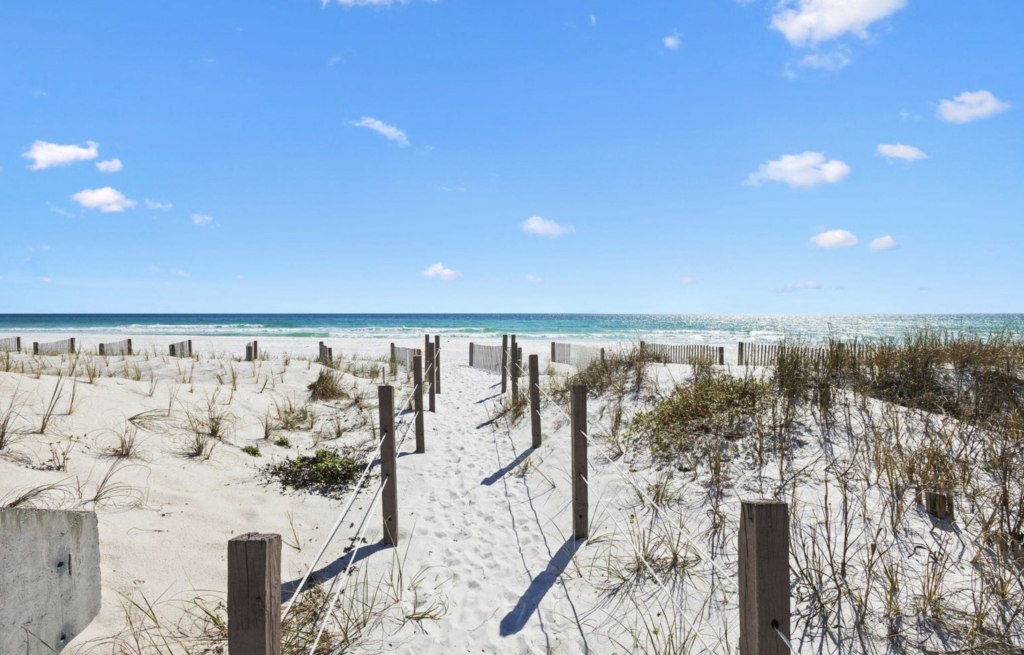
Inlet Beach Regional Access is the largest county-operated beach access on 30A. According to the South Walton Tourist Development Council, it features 117 parking spaces, three dune walkovers, restrooms, and seasonal lifeguard coverage.
The trade-off is real. This access point is positioned to absorb crowd overflow from Panama City Beach, and it does. On peak summer weekends, the lot fills by 9 AM. The atmosphere skews toward a casual beach party environment compared to Rosemary’s managed quiet.
For Inlet residents with private or semi-private beach access through their own subdivision, the regional access crowds are largely irrelevant. For buyers assuming the regional access is their primary beach point, this distinction matters considerably before you buy.
What Locals Know and Realtors Don’t Always Say
The Highway 98 Factor: Inlet Beach’s Identity Split
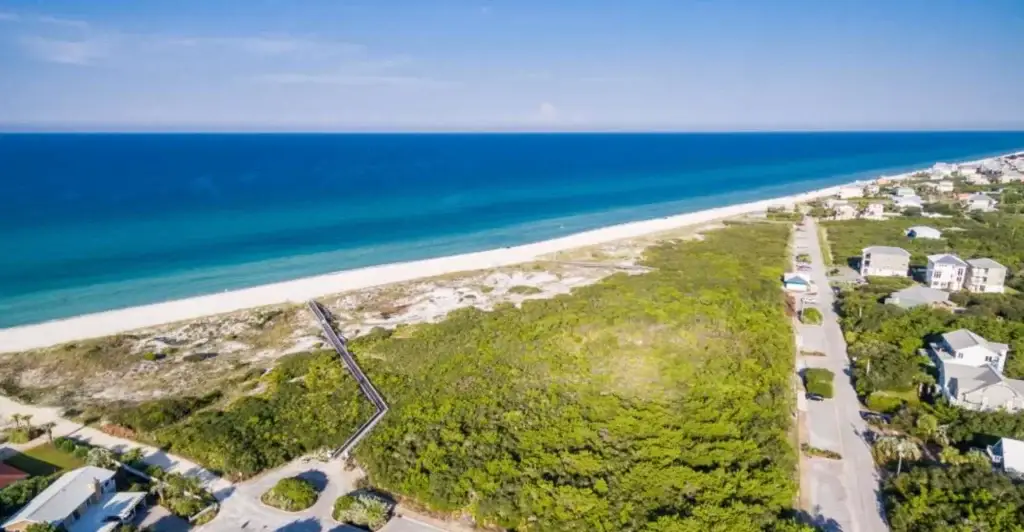
Here is the detail that rarely appears in MLS listings: Inlet Beach is bisected by Highway 98.
South of Highway 98: True beach town living. Direct Gulf access. The highest valuations in Inlet Beach. This is what most buyers picture when they search “Inlet Beach.”
North of Highway 98: The 30Avenue development area offers great shops and dining options. Often marketed as “Inlet Beach” in listings, but requires crossing a four-lane highway via the new underpass to reach the water. These properties can produce decent rental income, but they are a materially different product from beachside living.
Always verify map placement before assuming beach proximity. A home marketed as “Inlet Beach” might be north of 98. Getting oriented on the 30A corridor before you shop helps prevent this confusion. The south of 30A vs. north of 30A value breakdown explains why the highway divide dynamic affects property values across multiple communities on the corridor, not just Inlet Beach.
The Golf Cart Question
Golf carts are banned entirely from Rosemary Beach. Inlet Beach imposes no community-level golf cart restrictions, but golf carts cannot legally travel on Highway 98. Since many of Inlet Beach’s most popular communities sit north of 98, reaching the beach by golf cart would require navigating or crossing a four-lane highway. That is a dangerous and unnecessary risk. Unless your property is south of Highway 98, do not factor golf cart access into your Inlet Beach lifestyle expectations.
The Parking Reality
Rosemary Beach’s walkability is its signature feature and a genuine asset. The constraint is that your extended rental group may not share your enthusiasm for walking. A five-bedroom rental house in Rosemary typically provides one to two parking spots. Guests managing more vehicles frequently overflow to Inlet Beach Regional Access and shuttle in.
Inlet homes typically offer two to three car driveways with room for trailers. For rental operators managing large family groups, this operational difference is worth underwriting carefully. Buyers weighing parking and density trade-offs across the central portion of 30A can reference the Seaside vs. WaterColor comparison for how those communities handle similar challenges, along with the individual guides to living in Seaside and living in WaterColor.
2026 Side-by-Side Comparison: Inlet Beach vs. Rosemary Beach
| Factor | Inlet Beach | Rosemary Beach | Winner |
|---|---|---|---|
| Avg Price/SqFt | $517 – $669 | $1,784+ | Inlet Beach |
| Median List Price | $1,570,000 | $2,995,000 | Inlet Beach |
| YoY Price Trend | Down ~9% | Up 13.4% | Rosemary Beach |
| HOA Fees (Annual) | $0 in most of Inlet; up to ~$2,400/yr in some communities | $6,368/yr (single-family) to $20,576/yr (condo) | Inlet Beach |
| Architectural Control | Minimal to moderate | Strict (RBPOA review board) | Depends on buyer goals |
| Beach Access | Regional public (large, crowded) | Gated private (exclusive, chair-dominated) | Rosemary Beach |
| Parking | Driveways, boats and trucks welcome | Pads and garages, strictly enforced | Inlet Beach |
| Golf Carts | Allowed in community; impractical north of Hwy 98 | Banned entirely | Neither |
| Rental Nightly Rate | $400 – $800; up to $1,200 for premium gulf-front | $600 – $1,200+ | Comparable |
| Estimated Occupancy | 60 – 70% | 60 – 75% | Comparable |
| Gross Rental Income (top tier) | Up to $225,000/yr | Up to $200,000/yr | Inlet Beach |
| Yield on Purchase Price | Stronger cap rate at lower basis | Lower yield relative to purchase price | Inlet Beach |
| Best For | Rental ROI, flexibility, space | Walkability, brand protection, appreciation | Depends on buyer goals |
Market data reflects trailing 12-month averages as of February 2026. Verify all figures independently before making purchase decisions.
The Final Verdict: Who Should Buy Where?
The Investor Verdict: Inlet Beach
If you are underwriting this as a rental income play, Inlet Beach wins on cap rate, carry costs, and operational flexibility. Between the lower purchase price, minimal HOA obligations, and top-tier gross rental income that now rivals or exceeds Rosemary’s largest properties, the math consistently favors Inlet for buyers whose primary goal is return on invested capital.
The Lifestyle Verdict: Rosemary Beach
Choose Rosemary Beach if you value walkability, architectural uniformity, a curated private beach experience, and a community where the HOA protects your investment from aesthetic drift. The premium is substantial, and now you know exactly what it covers.
The Honest Take
Rosemary Beach is a lifestyle purchase. Inlet Beach is a real estate purchase. That price gap is either the cost of peace of mind or the price of brand positioning, depending on your priorities. Choose based on your actual goals, not the marketing narrative.
If Rosemary’s premium appeals to you and you are also weighing the corridor’s other luxury option, the Rosemary Beach vs. Alys Beach comparison covers the full luxury showdown at the east end of 30A. For buyers drawn to the west end as a value-oriented alternative to both communities, the guides to living in Grayton Beach and the Seagrove vs. Grayton Beach breakdown offer useful contrast on what the old-school 30A experience actually looks like in practice.
For property tax information specific to any parcel you are evaluating, the Walton County Property Appraiser provides public access to assessed values, millage rates, and tax history. For guidance on Florida homestead exemption eligibility, note that it does not apply to vacation or investment properties. The Florida Department of Revenue property tax page outlines which properties qualify.
Market data reflects trailing 12-month averages as of February 2, 2026. Real estate values fluctuate. Verify all numbers independently before making purchase decisions.
Frequently Asked Questions
Is Inlet Beach or Rosemary Beach better for short-term rental income?
For pure rental yield, Inlet Beach typically delivers stronger returns relative to purchase price. The lower entry cost means a smaller basis to recover, and top-tier Inlet properties now produce gross rental income up to $225,000 per year, which matches or exceeds what Rosemary’s largest homes generate. Rosemary commands premium nightly rates and strong occupancy, but the purchase price and HOA carry costs are high enough that cash-on-cash returns are more challenging to achieve. Buyers focused on income should underwrite both scenarios with current management company data before committing.
How much are Rosemary Beach HOA fees?
As of 2026, Rosemary Beach HOA fees run $1,592 per quarter for detached single-family homes ($6,368 per year) and $5,144 per quarter for condo units ($20,576 per year). These fees cover common area maintenance, pool access, fitness center, landscaping, security, and beach access management. Special assessments are possible for major community projects. Buyers should request the current RBPOA fee schedule and full CC&Rs as part of due diligence, as fees are subject to change.
What is the difference between north and south of Highway 98 in Inlet Beach?
Properties south of Highway 98 in Inlet Beach offer direct Gulf access and carry the highest valuations in the area. Properties north of Highway 98, including the 30Avenue and Big Chill developments, are frequently marketed as “Inlet Beach” but require crossing a four-lane highway via underpass to reach the water. North-of-98 properties can produce strong rental income and represent legitimate investment opportunities, but buyers should not assume they offer beachside living. Always verify a property’s position relative to Highway 98 before finalizing any decision.
Thinking about Inlet Beach or Rosemary Beach?
Let’s talk through the real numbers before you make a move. I work exclusively on 30A and can show you what the listing price doesn’t tell you.
850-585-0642
andy@livingon30aflorida.com

Pingback: Seagrove vs. Grayton Beach: 2026 30A Real Estate & Lifestyle Guide
Pingback: The Real 30A Florida Guide: Towns, Truths & East vs. West
Pingback: Getting to 30A: Closest Airports (ECP vs VPS) & Driving Routes
Pingback: South of 30A vs. North of 30A: Real Costs, Value & Data (2026)
Pingback: Living in Seaside FL: True Costs, HOA Rules & Reality (2026)
Pingback: Living in WaterColor FL: The Real Cost, Rules & Districts (2025)
Pingback: Living in Rosemary Beach: Design Code, Costs & HOA Rules
Pingback: Living in Alys Beach FL: The Ultimate Luxury Guide (2026 Costs & Rules)