

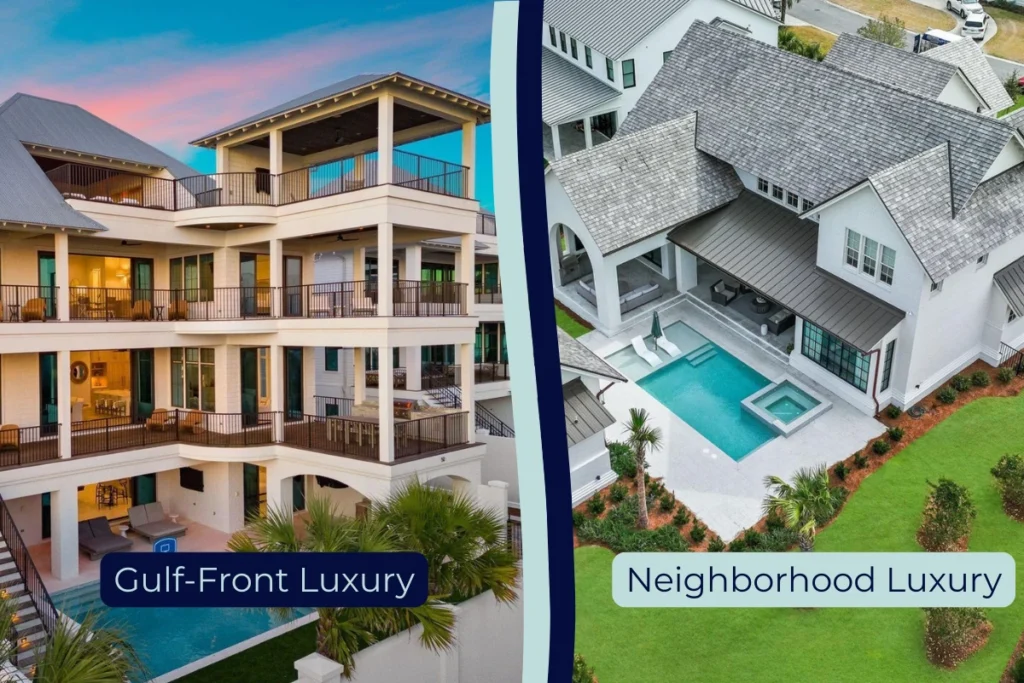
Every buyer exploring 30A eventually faces the same question: do you pay the premium to live south of Scenic Highway 30A on the beach side, or do you buy north of Highway 98 where the lots are bigger and the carrying costs are dramatically lower? The answer depends entirely on whether you’re chasing rental income or long-term value — and most guides oversimplify that math. If you’re still getting oriented to how the area is laid out, start with our complete 30A guide before diving into the numbers below.
Compare Your Options
- At a Glance: The “Vibe” vs. The Value
- The “Money” Difference: Price Per Sq. Ft. & ROI
- Hidden Costs: Insurance, HOAs, and Flood Zones
- Lifestyle & Laws: The “Vibe” Killers
- Final Verdict: Who Should Buy Where?
- Frequently Asked Questions
At a Glance: The “Vibe” vs. The Value
The primary difference between South of 30A and North of 30A is the balance of rental income vs. carrying costs. South of 30A properties average $891/sq. ft. and offer high short-term rental (STR) potential but require high-risk Flood Zone AE insurance and premium HOA fees. In contrast, North of 30A (North of 98) offers better value at $420–$600/sq. ft. and low-risk Flood Zone X status, making it the preferred choice for full-time residents and long-term investors seeking lower operational expenses.
| Factor | South of 30A | North of 30A (North of 98) |
|---|---|---|
| Price/Sq. Ft. | ~$891 | ~$420–$600 |
| Lifestyle | Tourist-driven, walkable to beach | Residential/forest vibe, car-dependent |
| Rental Income | High STR potential (57% occupancy 2025) | Minimal to none (most areas ban STRs) |
| Flood Zone | Mostly AE (high risk) | Mostly X (minimal risk) |
| Insurance | $1,000–$3,500/yr flood + high wind/hail | $500–$700/yr, lower premiums |
| HOA Fees | $1,000+/month (resort communities) | Low to none |
| Beach Access | Walk from your door | Drive + compete for parking |
| Lot Size | Compact (resort density) | Larger lots, more privacy |
The “Money” Difference: Price Per Sq. Ft. & ROI
Most real estate content stops at “North is cheaper.” Here’s the actual math that matters to your portfolio.
Price Per Square Foot Reality:
- South of 30A (East End communities): Properties average $891 per square foot. A 2,000 sq. ft. beach cottage runs $1.78M before you add furnishings or golf cart parking.
- North of 98 (Point Washington/Santa Rosa Beach): Properties average $420–$600 per square foot. You can acquire a 3,000 sq. ft. home with acreage for $1.26M–$1.8M—nearly double the house for comparable money.
If you are looking for the absolute highest ROI on the South side, compare the value of Rosemary Beach vs. Alys Beach.
The Gross Rental Multiplier (GRM) Test:
South of 30A investors target a GRM of 6–10 (purchase price divided by annual rental income). A $1.5M property generating $180K annually hits a GRM of 8.3—acceptable in high-demand beach markets, especially in communities like Alys Beach where rental premiums are highest.
North of 30A properties rarely qualify as short-term rental investments. Zoning restrictions in neighborhoods like Point Washington effectively ban STRs, converting these into long-term appreciation plays rather than cash flow assets. For buyers considering this path, here’s what full-time 30A life actually costs.
2025 Rental Revenue Trends:
While South of 30A occupancy dipped to 41.5% in 2024, the market rebounded in 2025 to 57% occupancy with revenue up 8%. This volatility is the cost of owning South—your income swings with tourism sentiment, hurricane seasons, and economic cycles. North properties offer stable, predictable expenses without the revenue rollercoaster.
The Hidden Costs: Insurance, HOAs, and Flood Zones
This section separates amateur investors from professionals. These “boring” line items determine whether your property generates cash or bleeds capital.
Flood Zone Mathematics:
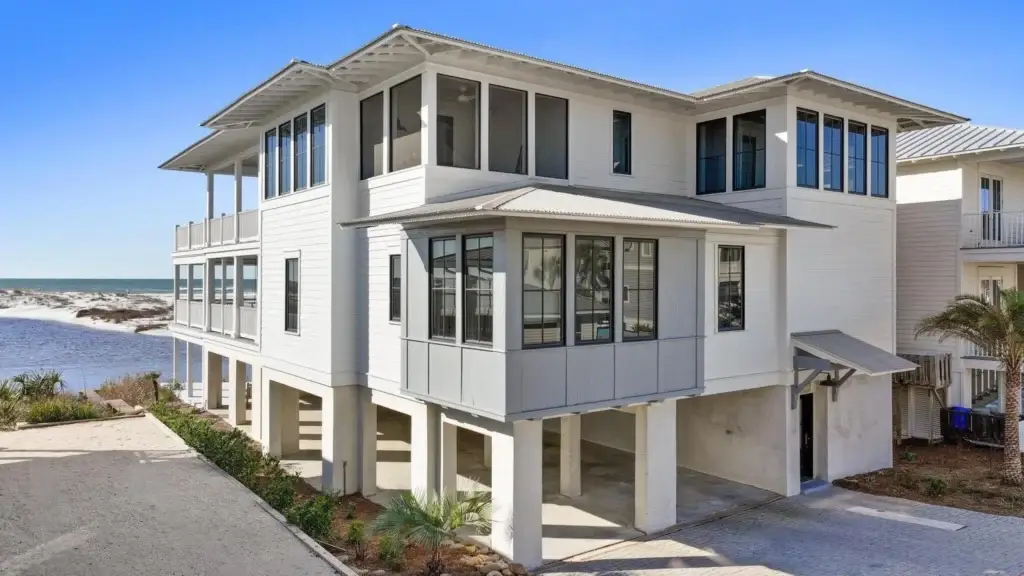
- South of 30A (High Risk): Most properties sit in Flood Zone AE, requiring federal flood insurance. Annual premiums range from $1,000–$3,500 for standard structures. Elevated luxury builds can exceed $5,000 annually. FEMA’s Risk Rating 2.0 methodology increased these premiums 18% year-over-year in many coastal zones.
- North of 30A (Low Risk): Properties typically occupy Flood Zone X, eliminating federal insurance requirements. Optional private flood coverage costs $500–$700 annually—a $2,000–$3,000 annual savings that compounds over a 30-year hold.
Lower insurance costs are a major perk of the West end; see how this impacts my Seagrove vs. Grayton Beach analysis and our guide to living in Grayton Beach.
Learn more about zoning at the Walton County GIS Website.
Wind & Hail Premium Gap:
Coastal properties (South) face double to triple the wind and hail premiums compared to inland (North) homes. A $1.5M property South of 30A carries $4,000–$8,000 in annual wind coverage. The same value North of 98 runs $2,000–$3,500. Over 10 years, this $3,000/year delta represents $30,000 in saved capital.
HOA Fee Reality:
Premium South of 30A communities (WaterColor, Rosemary Beach, Alys Beach) charge $1,000–$2,500 monthly charge $1,000–$2,500 monthly for amenities like beach clubs, pools, and landscaping. These fees are non-negotiable and escalate 3–5% annually.
North of 98 neighborhoods feature low to zero HOA fees. Point Washington and Santa Rosa residential areas often operate without formal HOAs, eliminating this recurring expense entirely. For buyers holding properties 15+ years, this represents $180,000–$450,000 in avoided fees.
Lifestyle & Laws: The “Vibe” Killers
The gap between South and North extends beyond spreadsheets into daily living friction and legal constraints.
Short-Term Rental (STR) Restrictions:
- South of 30A: STR-friendly with strict enforcement. Walton County caps occupancy at 2 guests per bedroom + 2 additional. A 4-bedroom home maxes at 10 guests. Violations trigger $250–$500 daily fines. However, the regulatory framework supports STR operations with clear permitting processes.
- North of 30A: Many residential zones fall under “Neighborhood Preservation” zoning, effectively banning short-term rentals. Areas like Point Washington prioritize full-time residents and seasonal snowbirds. This creates a quiet, stable neighborhood environment but eliminates Airbnb revenue potential. Verify zoning before purchase—county maps show rental restrictions by parcel.
Traffic & Access Patterns:
- South of 30A: Golf cart culture dominates. Once you arrive at your property, you rarely need a car. Scenic Route 30A handles ~28,000 vehicles daily (AADT) during peak season, creating seasonal gridlock between Seaside and Rosemary Beach. The stress is stop-and-go congestion, not speed. Pedestrian infrastructure makes car-free living viable.
- North of 30A: Highway 98 serves as the primary high-speed arterial corridor and evacuation route. You drive everywhere—groceries, restaurants, beach access. While traffic moves faster than 30A, the highway features 45–55 mph speeds with commercial trucks, commuters, and tourist traffic mixing. For families with teenage drivers or young children, this represents a different safety calculus than 30A’s low-speed gridlock. Car-dependency becomes the baseline reality for full-time residents.
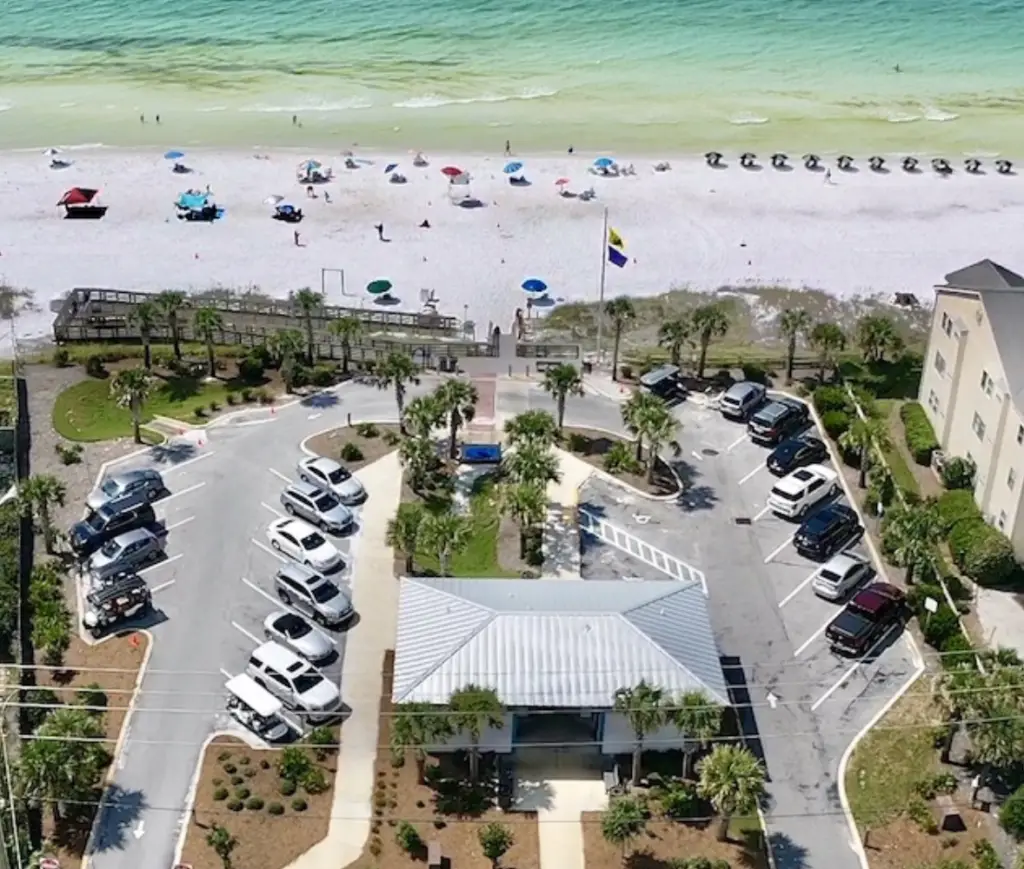
Beach Access Friction:
Living North of 30A means driving to public access points like Ed Walline, Inlet Beach, or Miramar Beach. Parking constraints create competition:
- Ed Walline Access: ~60 parking spots
- Miramar Beach Access: ~200 spots
- Inlet Beach Access: ~40 spots
During summer weekends and spring break, these lots fill by 9:00 AM. South of 30A owners walk to private beach access or deeded public walkways—no parking lottery required.
Before you commit to a North-side property, make sure you understand the public vs. private beach access rules that affect your daily commute.
Final Verdict: Who Should Buy Where?
Buy South of 30A if:
- Cash flow is priority #1. You need the property to generate $100K+ annually through short-term rentals to justify the acquisition cost.
- You hate driving. Golf cart accessibility and walkable restaurants/shops matter more than square footage. Communities like Seaside and WaterColor are built for this.
- You want the “resort” experience. Professionally managed communities, concierge services, and hotel-like amenities justify the premium.
- You’re holding <10 years. Short-term appreciation in branded communities (Alys, Rosemary) can outpace North’s slower growth during bull markets.
Buy North of 30A if:
- You want 3,000+ sq. ft. for under $1.5M. Space, privacy, and acreage matter more than beach proximity.
- You live here full-time or spend winters here. Without STR income, you need the lower carrying costs (insurance, HOA, taxes) that North provides.
- You prioritize stability over volatility. Predictable expenses and fewer tourism-dependent variables create financial certainty.
- You’re a long-term holder (15+ years). Appreciation in Point Washington and Santa Rosa has been steady at 4–6% annually—not explosive, but reliable.
Bottom Line: South of 30A trades at luxury resort economics—high entry cost, high revenue potential, high operational complexity. North of 30A operates on residential fundamentals—value acquisition, lower holding costs, lifestyle-driven appreciation. Neither is “better.” The right choice depends on whether your spreadsheet prioritizes cash-on-cash return (South) or cost-per-square-foot value (North). Either way, timing your visit to scout properties during off-season can save you money on both sides.
Frequently Asked Questions
- Is North of 30A considered a good investment? Yes, but the strategy is different. North of 30A is a long-term appreciation play with much lower carrying costs (insurance and HOAs), whereas South of 30A is a cash-flow play driven by short-term rental revenue.
- Can I do Airbnb North of 30A? It depends on the specific zoning. Many neighborhoods like Point Washington are zoned “Neighborhood Preservation,” which bans short-term rentals to protect full-time residents. Always verify zoning parcel-by-parcel before buying.
- How much can I save on insurance North of 30A? By moving from Flood Zone AE (South) to Flood Zone X (North), owners typically save $2,000–$4,000 annually in flood and wind premiums alone.
South or North: Which Side of 30A Wins for Your Portfolio?
Don’t guess on these important topics as you explore your best move. Let’s look at the actual numbers for the properties you’re considering.

Pingback: Getting to 30A: Closest Airports (ECP vs VPS) & Driving Routes
Pingback: 30A Beach Access: Public vs. Private Rules (2026 Guide)
Pingback: Living in Seaside, FL: The True Cost of New Urbanism
Pingback: Living in WaterColor FL: The Real Cost, Rules & Districts (2025)
Pingback: Living in Rosemary Beach: Design Code, Costs & HOA Rules
Pingback: Living in Alys Beach FL: The Ultimate Luxury Guide (2026 Costs & Rules)
Pingback: Living in Grayton Beach, FL: Costs, Pros & The “Strange” Truth
Pingback: Seaside vs. WaterColor: Which 30A Town is Best for Families?
Pingback: WaterColor vs Watersound Beach: Cost, Rules & Honest Comparison (2026)
Pingback: Moving to 30A: Relocation Guide (Schools, Internet & Utilities)