

What is the Current State of 30A Beach Access?
30A beach access is governed by a mix of public regional accesses and private property rights. As of 2026, Walton County recognizes “Customary Use” in specific areas, but many beachfront parcels remain private to the mean high-water line. Stationary lounging requires identifying designated public beach zones. For a full overview of the corridor, see our complete 30A guide.
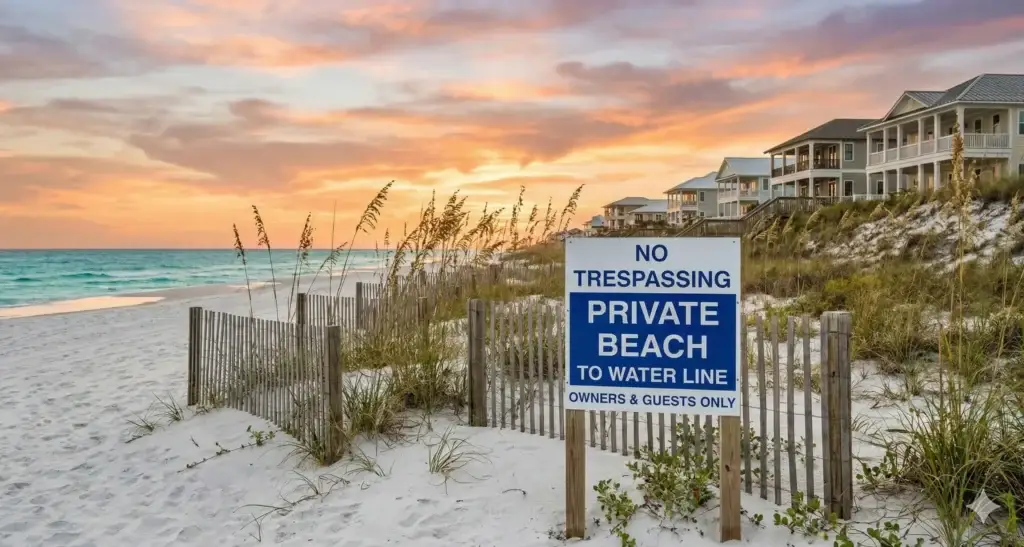
The Golden Rule: Where You Can Legally Sit
In Walton County, the wet sand—the area south of the Mean High Water Line where waves wash over your feet—is public property held in trust by the state of Florida. The dry sand above this line is private property, unless you’re at a designated public beach access point or an Erosion Control Line (ECL) has been established. That’s the rule that determines whether you’re legal or trespassing.
If you want the most laid-back version of these rules, Living in Grayton Beach offers a look at the ‘strange’ local vibe — and our Seagrove vs Grayton Beach comparison covers how the west end handles beach access more casually than the east.
The Invisible Lines That Actually Matter
Most visitors to 30A never learn about the technical boundaries that determine their beach rights — and many don’t realize how dramatically the real value differences between south and north of 30A affect which beaches they can access.
These boundaries are legally defined by the state; you can review the official Florida DEP Beach Boundary guidelines to see how the Mean High Water Line is maintained.
The Mean High Water Line (MHWL): The Moving Boundary
The Mean High Water Line sits at 1.34 feet above Mean Lower Low Water, as established by NOAA tidal data. Here’s what matters: this line moves with the tides and seasons. If the water touches the sand where you’re sitting during normal high tide conditions, you’re on public property. The wet sand rule isn’t just a guideline—it’s based on this surveyed elevation that defines state-owned submerged lands.
Think of it this way: if you can see the sand darkened by water or feel it damp beneath your towel, you’re almost certainly in the public zone.
The Erosion Control Line (ECL): The Game-Changing Loophole
This is where things get interesting, and where many beach homeowners would prefer you stay confused. When beaches along 30A were restored and renourished using taxpayer dollars (which includes most of the scenic Highway 30A corridor), the state established an Erosion Control Line under Florida Statute 161.191.
Here’s the crucial part: anything seaward (beach-side) of the ECL is state-owned public land, even if it looks and feels like dry sand sitting directly in front of a $5 million beach house. The ECL fixes the boundary permanently, unlike the moving Mean High Water Line. On renourished beaches, the public’s rights extend much further up the beach than most private property owners want to acknowledge.
You won’t see the ECL marked with signs or stakes, but it exists in county records. This is the legal foundation that allows the public to use large sections of what appears to be “private” dry sand.
In high-end enclaves, these lines are strictly enforced; see our Alys Beach 2026 Guide for the specifics on ‘fortified wealth,’ and our Rosemary Beach vs Alys Beach comparison for how enforcement differs between the two.
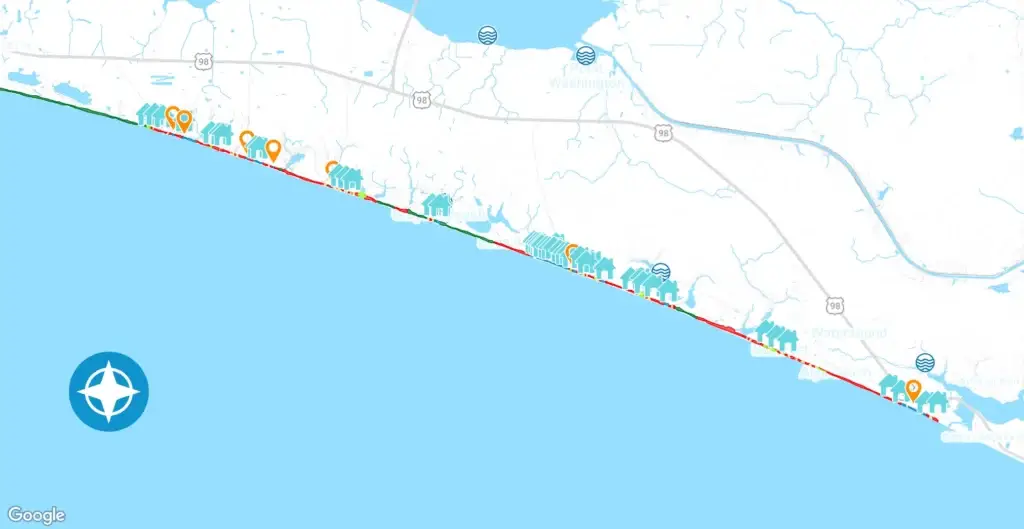
Public Beaches on 30A: Regional vs. Neighborhood Access
Treating every beach access the same way is how tourists end up with $150 towing bills and ruined vacation days.
Regional Access Points are your safest bet, especially in the east end corridor where communities like Seaside and WaterColor draw the heaviest foot traffic. Places like Blue Mountain Beach Regional Access, Ed Walline Beach Access, and Santa Clara Regional Beach Access offer public parking (though it fills early in summer), restrooms, and often lifeguards during peak season. You can spend all day here without worry. Parking is typically $20-30 in high season.
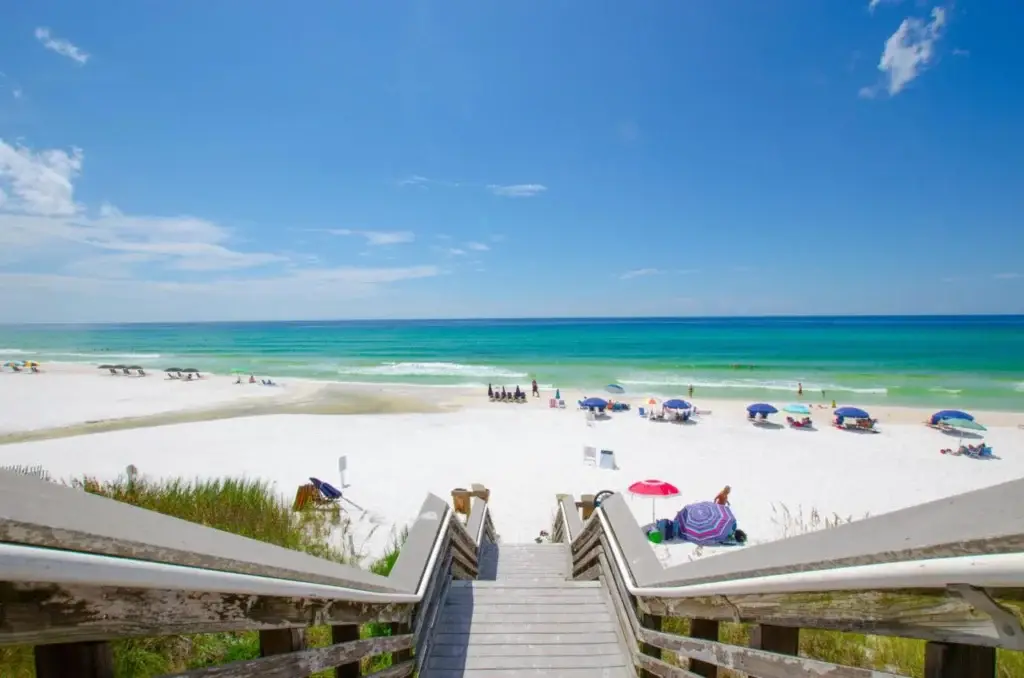
Neighborhood Access Points are the traps — and nowhere is this more evident than in Seaside, where narrow access paths serve a community that draws thousands of daily visitors. These are the narrow paths—often just wooden stairs—that serve nearby residents. They’re technically open to the public for beach access, but here’s what the signs won’t tell you clearly: there is absolutely no parking. Not on the street. Not in the grass. Not “just for a minute.” Walton County contracts aggressive towing companies who patrol these areas, and they’re especially vigilant about LSVs (golf carts). A golf cart parked near neighborhood access will be gone within an hour, and retrieval costs $200-300. This is especially true near gated communities — see how WaterColor and Watersound handle access differently.
Deeded Access means private easement, and planned communities like WaterColor use gated beach walkovers exclusively for residents and guests. If you see “Deeded Beach Access” or a gate with a keypad, keep moving. These serve specific subdivisions or condo complexes. Using them without authorization is trespassing, plain and simple.
For a real-time map and a complete list of amenities at every stop, refer to the Walton County Beach Operations map before you head out.
The Transitory Zone: Understanding Your 20-Foot Buffer
While the controversial HB 631 law was repealed by Senate Bill 1622 in 2025, returning more power to local governments, the Transitory Zone settlement remains the most practical rule for visitors right now. This gives the public rights to use approximately 20 feet from the water’s edge, even on portions of dry sand that might otherwise be considered private.
You can walk, sit, swim, build sandcastles, and engage in typical beach activities within this zone. What you cannot do is treat it like a campsite. The county prohibits large tents, 10×10 pop-up canopies, and elaborate setups that suggest permanent occupation. The philosophy is “transitory”—you’re passing through and enjoying the beach temporarily, not staking a claim. For those considering living on 30A full-time, knowing these boundaries becomes part of daily life.
There’s also a practical spacing rule: beach furniture and umbrellas should maintain at least 5 feet between setups. Private property owners can still ask you to move if you’re lingering immediately adjacent to their beach structures or dune walkovers outside the recognized transitory area — a dynamic that plays out very differently in value-oriented neighborhoods like Inlet Beach compared to branded Rosemary Beach. The smart move? Stay mobile, keep your setup minimal, and don’t argue.
The Vendor Wars: Why Those Empty Chairs Are Blocking Your Spot
Here’s a scene that infuriates visiting families daily: you arrive at the beach at 10 AM and see rows of empty vendor chairs planted on the dry sand. You set up your own chairs nearby, and within 20 minutes a vendor approaches saying you’re in their “permitted zone.”
This is the business side of 30A beach access, and it’s especially pronounced in front of high-value communities like Rosemary Beach where vendor zones dominate the dry sand. Under Walton County Beach Code Chapter 22, commercial beach vendors pay substantial fees (starting at $1,000 per location) to permit specific zones for their rental operations. These zones are typically landward of the Erosion Control Line, on what would otherwise be considered the less-contested dry sand areas.
The frustrating reality is what locals call the “Ghost Town” issue: vendor chairs often sit completely empty until 4 or 5 PM when renters finally make their way to the beach. Meanwhile, families who brought their own gear are turned away from perfectly good beach space. The vendors have legal permits for these zones, so they’re within their rights to control the space, even if their chairs sit unused.
Your legal workaround? Set up on the wet sand seaward of their operations. It’s public property, it’s legal, and vendors cannot exclude you from that area. It’s not always the prime spot—you might get occasional wave wash—but it’s yours by right. The county has a Code Compliance Committee that handles disputes, but immediate enforcement almost always favors the permitted vendor.
The Rules Everyone Ignores (Until They Get Fined)
Bonfires require advance permits under Chapter 22 of the beach code. The permit costs approximately $150 (combined fees for the Fire District and County) and must be booked in advance. The permit process takes several days and includes specific requirements for fire size, beach location, and cleanup. That romantic beach bonfire you’re imagining? Plan ahead or skip it.
Overnight gear is confiscated. The Tourist Development Council (TDC) has maintenance crews that sweep the beaches in the early morning. Tents, canopies, or elaborate setups left overnight are removed and discarded. The county’s position is clear: Leave No Trace. If it’s still there at sunrise, it becomes litter.
Trespassing enforcement is aggressive. Private beachfront owners along 30A use prominent signage, security patrols, and in some cases, off-duty law enforcement to protect their perceived property rights. If security approaches you, do not engage in legal debates about Mean High Water Lines or Erosion Control Lines. Simply move to the visibly wet sand and continue your day. You can be right and still have your afternoon ruined.
Alcohol policies vary by location. County-managed beaches generally allow alcohol in cans or plastic containers—no glass. However, alcohol is strictly prohibited in state parks, including the popular Grayton Beach State Park and Deer Lake State Park. This catches visitors off-guard constantly. A cooler full of beer is fine at Blue Mountain Beach Regional Access but will result in citations at Grayton. Know which jurisdiction you’re in.
How to Be a Smart 30A Beach Visitor
Don’t just show up and hope for the best — especially if you’re still figuring out getting to 30A and haven’t planned your route yet. The Walton County TDC maintains a Beach Maintenance Map that shows public access points, amenities, and areas where the county actively maintains the shoreline. If the county is cleaning and maintaining the sand, that’s generally a reliable indicator that public access rights are well-established in that area.
Use regional access points with parking when possible. Arrive early in summer—by 9 AM on weekends, popular spots are at capacity. Keep your beach setup minimal and mobile. Stay on wet sand if there’s any question about boundaries. And remember: the invisible lines we’ve discussed—the Mean High Water Line and the Erosion Control Line—are your legal protection, even if property owners don’t want to acknowledge them.
The beaches of 30A are some of the most beautiful in Florida, and understanding access rules is essential whether you’re visiting or moving to 30A full-time. Understanding the rules means you can enjoy them without the stress, confrontation, or unexpected costs that trap less-informed visitors.
Timing is everything; use our Best Time to Visit 30A Guide to avoid the ‘Vendor War’ crowds.
FAQ: Frequently Asked Questions
Where can I legally sit on the beach on 30A?
In Walton County, the wet sand (south of the Mean High Water Line) is public property held in trust by the state. The dry sand is private property, unless you are at a designated public beach access point or in an area where an Erosion Control Line (ECL) has been established.
What is the difference between Regional and Neighborhood beach access on 30A?
Regional Access Points offer public parking, restrooms, and often lifeguards. Neighborhood Access Points are smaller paths (often stairs) intended for walk-up traffic only; they strictly prohibit parking—including golf carts/LSVs—and towing is aggressively enforced.
What is the Transitory Zone on 30A beaches?
The Transitory Zone is a settlement-established buffer allowing public use of approximately 20 feet from the water’s edge, even on some private dry sand. Within this zone, you can walk, sit, or swim, but you cannot set up large tents (camping) or 10×10 canopies, and you must generally keep 5 feet of spacing from other setups.
Confused by 30A Beach Rights?
Whether you are buying or selling, beach access is the #1 factor in property value. Let’s discuss your goals.

Pingback: Getting to 30A: Closest Airports (ECP vs VPS) & Driving Routes
Pingback: South of 30A vs. North of 30A: Real Costs, Value & Data (2026)
Pingback: Living in Seaside FL: True Costs, HOA Rules & Reality (2026)